08 Model-Free Control (SARSA & Q-Learning)
Slides
This module is also available in the following versions
Model-Free Reinforcement Learning
Last Module (6):
Model-free prediction
Prediction: Optimise the value function of an unknown MDP
This Module (7):
Model-free control
Control: Learn model directly from experience
Model-Free Control (SARSA & Q-Learning)
Uses of Model-Free Control
Example problems that can be naturally modelled as MDPs
- Elevator
- Parallel Parking
- Ship Steering
- Bioreactors
- Power stations
- Computer Programming
- Fine tuning LLMs
- Portfolio management
- Protein Folding
- Robot walking
For most of these problems, either:
- MDP model is unknown, but experience can be sampled
- MDP model is known, but is too big to use, except by samples
Model-free control can solve these problems
On and Off-Policy Learning
On-policy learning
“Learn on the job”
Learn about policy \(\pi\) from experience sampled from \(\pi\)
Off-policy learning
“Look over someone’s shoulder”
Learn about policy \(\pi\) from experience sampled from \({\color{red}{\mu}}\)
Off-policy learning uses trajectories sampled from policy \({\color{red}{\mu}}\), e.g. from another robot, AI agent, human, or simulator.
On-Policy Monte-Carlo Control
Generalised Policy Iteration
Alternation converges on optimal policy \(\pi_\ast\)
Policy evaluation Estimate \(v_{\pi}\)
e.g. Iterative policy evaluation, going upPolicy improvement Generate \(\pi^{\prime} \geq \pi\) e.g. Greedy policy improvement, act greedily with respect to value function, going down
Principle of Optimality
Any optimal policy can be subdivided into two components:
An optimal first action \(A_*\)
Followed by an optimal policy from successor state \(S'\)
Generalised Policy Iteration with Monte-Carlo Evaluation
Policy evaluation 1. Can we use Monte-Carlo policy evaluation to estimate \({\color{blue}{V = v_{\pi}}}\)(running multiple episodes/rollouts)?
Policy improvement 2. Can we do greedy policy improvement with MC evaluation?
Model-Free Policy Iteration Using Action-Value Function
- Problem 1: Greedy policy improvement over \(V(s)\) requires a model of MDP
\[ \pi'(s) \;=\; \arg\max_{a \in \mathcal{A}} \Big[ \mathcal{R}^a_s \;+\; {\color{red}{\sum_{s'} P^a_{ss'} \, V(s')}} \Big] \]
- Alternative: use action-value functions in place of model Greedy policy improvement over \(Q(s,a)\) is model-free
\[ \pi'(s) \;=\; \arg\max_{a \in \mathcal{A}} Q(s,a) \]
Generalised Policy Iteration with Action-Value Function
Policy evaluation We run Monte-Carlo policy evaluation using \({\color{red}{Q=q_\pi}}\)
For each state-action pair \(Q(A,S)\) we take mean return
We do this for all states and actions, i.e. we don’t need model
Policy improvement Greedy policy improvement?
Problem 2: We are acting greedily which means you can get stuck in local minima
Note that at each step we are running episodes for the policy by trial and error, so we might not see some states
i.e. you won’t necessarily see the states you need in order to get get correct estimate of value function
Unlike in dynamic programming where you see all states
Example of Greedy Action Selection (Bandit problem)

There are two doors in front of you.
You open the left door and get reward \(0\)
\({\color{red}{V(\textit{left}) = 0}\ (\textit{Monte Carlo Estimate})}\)You open the right door and get reward \(+1\)
\({\color{red}{V(\textit{right}) = +1}}\)You open the right door and get reward \(+3\)
\({\color{red}{V(\textit{right}) = +2}}\)You open the right door and get reward \(+2\)
\({\color{red}{V(\textit{right}) = +2}}\)
\(\vdots\)
You may never explore left door again!
- i.e. are you sure you’ve chosen the best door?
\(\varepsilon\)-Greedy Exploration
The simplest idea for ensuring continual exploration:
All \(m\) actions are tried with non-zero probability
with probability \(1 - \varepsilon\) choose the best action, greedily
with probability \(\varepsilon\) choose a random
\[ \pi(a \mid s) = \begin{cases} \dfrac{\varepsilon}{{\color{blue}{m}}} + 1 - \varepsilon & \text{if } a^* = \arg\max\limits_{a \in \mathcal{A}} Q(s,a) \\ \dfrac{\varepsilon}{{\color{blue}{m}}} & \text{otherwise} \end{cases} \]
\(\varepsilon\)-Greedy Policy Improvement
\[\begin{align*} q_\pi(s, \pi'(s)) & = \sum_{a \in \mathcal{A}} \pi'(a \mid s) \, q_\pi(s,a) \\[0pt] & = \tfrac{\varepsilon}{m} \sum_{a \in \mathcal{A}} q_\pi(s,a) + (1 - \varepsilon) \max_{a \in \mathcal{A}} q_\pi(s,a) \\[0pt] & \geq \tfrac{\varepsilon}{m} \sum_{a \in \mathcal{A}} q_\pi(s,a) + (1 - \varepsilon) \sum_{a \in \mathcal{A}} \frac{\pi(a \mid s) - \tfrac{\varepsilon}{m}}{1 - \varepsilon} \, q_\pi(s,a) \\[0pt] & = \sum_{a \in \mathcal{A}} \pi(a \mid s) \, q_\pi(s,a) = v_\pi(s) \end{align*}\]
Proof idea: \({\color{blue}{\max_{a \in \mathcal{A}} q_\pi(a,a)}}\) is at least as good as any weighted sum of all of your actions; therefore from the policy improvement theorem, \(v_{\pi'}(s) \;\geq\; v_\pi(s)\)
Monte-Carlo Policy Iteration
Policy evaluation Monte-Carlo policy evaluation, \(Q=q_\pi\)
Policy improvement \({\color{red}{\varepsilon-}}\)Greedy policy improvement
Monte-Carlo Control
Every episode:
Policy evaluation Monte-Carlo policy evaluation, \({\color{red}{Q \approx q_\pi}}\)
- Not necessary to fully evaluate policy every time, going all the way to the top, instead, immediately improve policy for every episode
Policy improvement \(\varepsilon-\)Greedy policy improvement
Greedy in the Limit with Infinite Exploration (GLIE)
For example, \(\varepsilon\)-greedy is GLIE if \(\varepsilon_k\) reduces to zero at \(\varepsilon_k = \tfrac{1}{k}\)
- i.e. decay \(\varepsilon\) over time according to a hyperbolic schedule
Note that the term \(\mathbf{1}(S_t = s)\) is an indicator function that equals \(1\) if the condition inside is true, and \(0\) otherwise.
\[ \mathbf{1}(S_t = s) = \begin{cases} 1, & \text{if } S_t = s \\ 0, & \text{otherwise} \end{cases} \]
It acts as a selector that ensures the update is applied only to the state currently being visited.
- The boldface notation \(\mathbf{1}(S_t = s)\) simply emphasises that this is a function, not a constant.
GLIE Monte-Carlo Control
Sample \(k\)th episode using \(\pi\): \(\{ S_1, A_1, R_2, \ldots, S_T \} \sim \pi\)
For each state \(S_t\) and action \(A_t\) in the episode update an incremental mean,
\[\begin{align*} N(S_t, A_t) \;\;& \leftarrow\;\; N(S_t, A_t) + 1\\[0pt] Q(S_t, A_t) \;\;& \leftarrow\;\; Q(S_t, A_t) + \frac{1}{N(S_t, A_t)} \Big( G_t - Q(S_t, A_t) \Big) \end{align*}\]
Improve policy based on new action–value function, replacing Q values at each step
\[\begin{align*} \varepsilon \;& \leftarrow\; \tfrac{1}{k}\\[0pt] \pi \;& \leftarrow\; \varepsilon\text{-greedy}(Q) \end{align*}\]
- In practice don’t need to store \(\pi\), just store \(Q\) (\(\pi\) becomes implicit)
Converges to the optimal policy, \(\pi_\ast\)
Every episode Monte-Carlo is substantially more efficient than running multiple episodes at each step
Back to the Blackjack Example

Monte-Carlo Control in Blackjack

Monte-Carlo Control algorithm finds the optimal policy!
(Note: Stick is equivalent to hold in this Figure)
On-Policy Temporal-Difference Learning
MC versus TD Control (Gain efficiency by Bootstrapping)
Temporal-difference (TD) learning has several advantages over Monte-Carlo (MC)
Lower variance
Online (including non-terminating)
Incomplete sequences
Natural idea: use TD instead of MC in our control loop
Apply TD to \(Q(S,A)\)
Use \(\varepsilon\)-greedy policy improvement
Update every time-step
Updating Action-Value Functions with SARSA

\[ Q(S,A) \;\leftarrow\; Q(S,A) + \alpha \Big({\color{blue}{R + \gamma Q(S',A')}} - Q(S,A) \Big) \]
Starting in state-action pair \(S,A\), sample reward \(R\) from environment, then sample our own policy in \(S^{\prime}\) for \(A^{\prime}\) (note \(S^{\prime}\) is chosen by the environment)
- Moves \(Q(S,A)\) value in direction of TD Target - \(Q(S,A)\) (as in Bellman equation for Q).
On-Policy Control with SARSA
Every time-step:
Policy evaluation SARSA, \(Q \approx q_\pi\)
Policy improvement \(\varepsilon-\)Greedy policy improvement
SARSA Algorithm for On-Policy Control
RHS of \(Q(S,A)\) update is on-policy version of Bellman equation—expectation of what happens in environment to state \(S^{\prime}\) and what happens under our own policy from that state \(S^{\prime}\) onwards.
Convergence of SARSA (Stochastic optimisation theory)
Tells us that step sizes must be sufficiently large to move us as far as you want; and changes to step sizes must result in step eventually vanishing
Windy Gridworld Example

Numbers under each column is how far you get blown up per time step
- Reward \(= -1\) per time-step until reaching goal
(Undiscounted and uses fixed step size \(\alpha\) in this example)
SARSA on the Windy Gridworld
Episodes completed (vertical axis) versus time steps (horizontal axis)
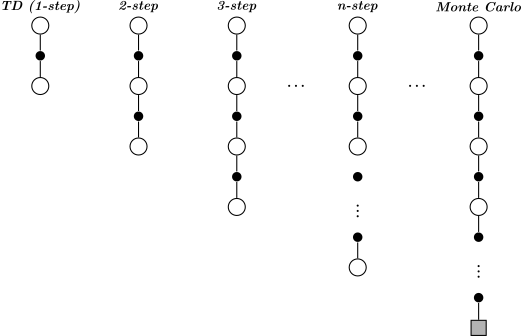
\(n\)-Step SARSA (Bias-variance trade-off)
Consider the following \(n\)-step returns for \(n = 1, 2, \infty\):
\[\begin{align*} {\color{red}{n}} & {\color{red}{= 1\ \ \ \ \ \text{(SARSA)}}} & q_t^{(1)} & = R_{t+1} + \gamma Q(S_{t+1})\\[0pt] {\color{red}{n}} & {\color{red}{= 2}} & q_t^{(2)} & = R_{t+1} + \gamma R_{t+2} + \gamma^2 Q(S_{t+2})\\[0pt] & {\color{red}{\vdots}} & & \vdots \\[0pt] {\color{red}{n}} & {\color{red}{= \infty\ \ \ \ \text{(MC)}}} & q_t^{(\infty)} & = R_{t+1} + \gamma R_{t+2} + \ldots + \gamma^{T-1} R_T \end{align*}\]
Define the \(n\)-step Q-return:
\[ q_t^{(n)} = R_{t+1} + \gamma R_{t+2} + \ldots + \gamma^{n-1} R_{t+n} + \gamma^n Q(S_{t+n}) \]
\(n\)-step SARSA updates \(Q(s,a)\) towards the \(n\)-step Q-return:
\[ Q(S_t, A_t) \;\leftarrow\; Q(S_t, A_t) + \alpha \Big( q_t^{(n)} - Q(S_t, A_t) \Big) \]
\(n=1\): high bias, low variance
\(n=\infty\): no bias, high variance
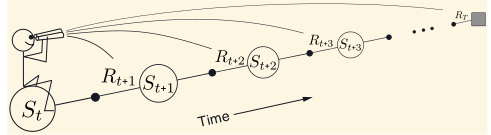
Forward View SARSA(\(\lambda\))
We can do the same thing for control as we did in model-free prediction:
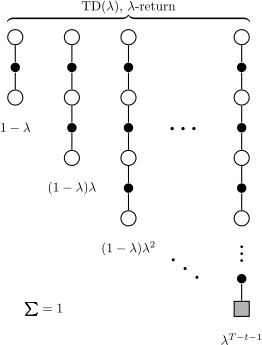
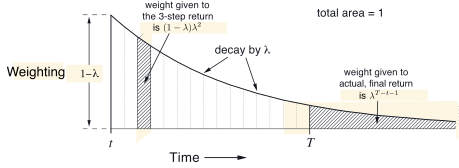
The \(q^\lambda\) return combines all \(n\)-step Q-returns \(q_t^{(n)}\)
Using weight \((1 - \lambda)\lambda^{n-1}\):
\[ q_t^\lambda \;=\; (1 - \lambda) \sum_{n=1}^{\infty} \lambda^{n-1} q_t^{(n)} \]
Forward-view SARSA(\(\lambda\)):
\[ Q(S_t, A_t) \;\leftarrow\; Q(S_t, A_t) + \alpha \Big( q_t^\lambda - Q(S_t, A_t) \Big) \]
Backward View SARSA(\(\lambda\))
Just like TD(\(\lambda\)), we use eligibility traces in an online algorithm
- However SARSA(\(\lambda\)) has one eligibility trace for each state–action pair
\[\begin{align*} E_0(s,a) & = 0 \\[0pt] E_t(s,a) & = \gamma \lambda E_{t-1}(s,a) + \mathbf{1}(S_t = s, A_t = a) \end{align*}\]
\(Q(s,a)\) is updated for every state \(s\) and action \(a\)
- In proportion to TD-error \(\delta_t\) and eligibility trace \(E_t(s,a)\)
\[ \delta_t = R_{t+1} + \gamma Q(S_{t+1}, A_{t+1}) - Q(S_t, A_t) \]
\[ Q(s,a) \;\leftarrow\; Q(s,a) + \alpha \,\delta_t \, E_t(s,a) \]
SARSA(\(\lambda\)) Algorithm
Algorithm updates all action-state pairs \(Q(s,a)\) at each step of an episode
SARSA(\(\lambda\)) Gridworld Example

SARSA(0) SARSA(\(\lambda\))
Assume initialise action-values to zero
Size of arrow indicates magnitude of \(Q(A,S)\) value for that state
SARSA updates all action-state pairs \(Q(s,a)\) at each step of episode
Off-Policy Learning
Off-Policy Learning
Evaluate target policy \(\pi(a \mid s)\) to compute \(v_\pi(s)\) or \(q_\pi(s,a)\)
while following a behaviour policy \(\mu(a \mid s)\)
\[ \{ S_1, A_1, R_2, \ldots, S_T \} \sim \mu \]
Why is this important?
Learning from observing humans or other agents (either AI or simulated)
Re-use experience generated from old policies \({\pi_1, \pi_2, \ldots, \pi_{t-1}}\)
Learn about optimal policy while following exploratory policy
Learn about multiple policies while following one policy
Importance Sampling
Estimate the expectation of a different distribution
\[\begin{align*} \mathbb{E}_{X \sim P}[f(X)] \;& =\; \sum P(X) f(X)\\[0pt] & = \sum Q(X) \, \frac{P(X)}{Q(X)} f(X)\\[0pt] & = \mathbb{E}_{X \sim Q} \!\left[ \frac{P(X)}{Q(X)} f(X) \right] \end{align*}\]
A technique for estimating expectations by sampling from different distributions
- Re-weights by dividing and multiplying samples to correct mismatch between expectations of the different distributions
Importance Sampling for Off-Policy Monte-Carlo
Use returns generated from \(\mu\) to evaluate \(\pi\)
Weight return \(G_t\) according to similarity between policies
Multiply importance sampling corrections along entire episode
\[ G_t^{\pi / \mu} = \frac{\pi(A_t \mid S_t)}{\mu(A_t \mid S_t)} \frac{\pi(A_{t+1} \mid S_{t+1})}{\mu(A_{t+1} \mid S_{t+1})} \cdots \frac{\pi(A_T \mid S_T)}{\mu(A_T \mid S_T)} G_t \]
Updates values towards corrected return
\[ V(S_t) \;\leftarrow\; V(S_t) + \alpha \Big( {\color{red}{G_t^{\pi / \mu}}} - V(S_t) \Big) \]
Cannot use if \(\mu\) is zero when \(\pi\) is non-zero
However, importance sampling dramatically increases variance, in case of Monte-Carlo learning
Importance Sampling for Off-Policy TD
Use TD targets generated from \(\mu\) to evaluate \(\pi\)
- Weight TD target \(R + \gamma V(S')\) by importance sampling
Only need a single importance sampling correction
\[ V(S_t) \;\leftarrow\; V(S_t) \;+\; \alpha \Bigg( {\color{red}{ \frac{\pi(A_t \mid S_t)}{\mu(A_t \mid S_t)} \Big( R_{t+1} + \gamma V(S_{t+1}) \Big)}} - V(S_t) \Bigg) \]
Much lower variance than Monte Carlo importance sampling (policies only need to be similar over a single step)
In practice you have to use TD learning when working off-policy (it becomes imperative to bootstrap)
Q-Learning
We now consider off-policy learning of action-values, \(Q(s,a)\)
No importance sampling is required using action-values as you can bootstrap as follows
Next action is chosen using behaviour policy \(A_{t+1} \sim \mu(\cdot \mid S_t)\)
But we consider alternative successor action \(A^{\prime} \sim \pi(\cdot \mid S_t)\)
\(\cdots\) and we update \(Q(S_t, A_t)\) towards value of alternative action
\[ Q(S_t, A_t) \;\leftarrow\; Q(S_t, A_t) + \alpha \Big( {\color{red}{R_{t+1} + \gamma Q(S_{t+1}, A')}} - Q(S_t, A_t) \Big) \]
Q-learning is the technique that works best with off-policy learning
Off-Policy Control with Q-Learning
We can now allow both behaviour and target policies to improve
- The target policy \(\pi\) is greedy w.r.t. \(Q(s,a)\)
\[ \pi(S_{t+1}) = \arg\max_{a'} Q(S_{t+1}, a') \]
- The behaviour policy \(\mu\) is e.g. \(\varepsilon\)-greedy w.r.t. \(Q(s,a)\)
The Q-learning target then simplifies according to:
\[\begin{align*} & R_{t+1} + \gamma Q(S_{t+1}, A')\\[0pt] = & R_{t+1} + \gamma Q\big(S_{t+1}, \arg\max_{a'} Q(S_{t+1}, a')\big)\\[0pt] = & R_{t+1} + \max_{a'} \gamma Q(S_{t+1}, a') \end{align*}\]
Q-Learning Control Algorithm

\[ Q(S,A) \;\leftarrow\; Q(S,A) + \alpha \Big( R + \gamma \max_{a'} Q(S',a') - Q(S,A) \Big) \]
Q-Learning Algorithm for Off-Policy Control
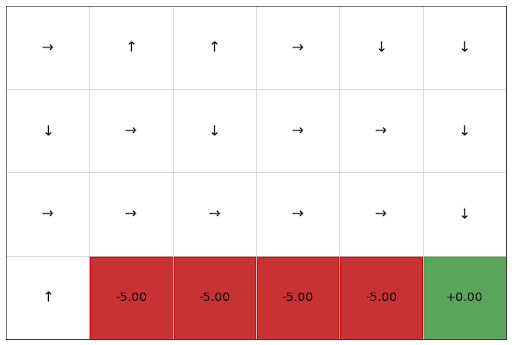
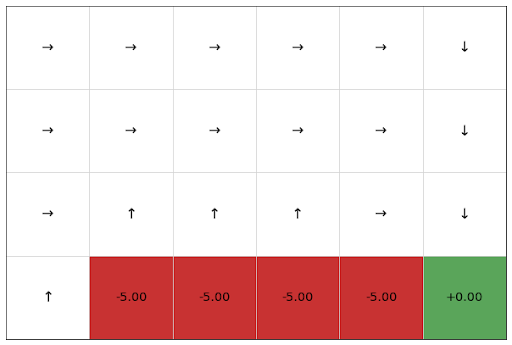
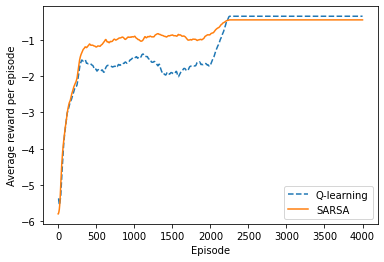
Cliff Walking Example (SARSA versus Q-Learning)
Relationship between Tree Backup and TD
Relationship between DP and TD
| Dynamic Programming (DP) | Sample Backup (TD) |
|---|---|
| Iterative Policy Evaluation \(V(s) \;\leftarrow\; \mathbb{E}[R + \gamma V(S') \mid s]\) |
TD Learning \(V(S) \;\xleftarrow{\;\alpha\;}\; R + \gamma V(S')\) |
| Q-Policy Iteration \(Q(s,a) \;\leftarrow\; \mathbb{E}[R + \gamma Q(S',A') \mid s,a]\) |
SARSA \(Q(S,A) \;\xleftarrow{\;\alpha\;}\; R + \gamma Q(S',A')\) |
| Q-Value Iteration \(Q(s,a) \;\leftarrow\; \mathbb{E}\!\left[R + \gamma \max_{a' \in \mathcal{A}} Q(S',a') \;\middle|\; s,a \right]\) |
Q-Learning \(Q(S,A) \;\xleftarrow{\;\alpha\;}\; R + \gamma \max_{a' \in \mathcal{A}} Q(S',a')\) |
where \(x \;\xleftarrow{\;\alpha\;} y \;\;\equiv\;\; x \;\leftarrow\; x + \alpha \,(y - x)\)
Reference Topics
See Appendix (Reference Topics) for details of Convergence & Contraction Mapping Theorem, and the relationship between Forward and Backward TD.