08 Model-Free Control (SARSA & Q-Learning)

Model-Free Reinforcement Learning

Last Module (6):

  • Model-free prediction

  • Prediction: Optimise the value function of an unknown MDP

This Module (7):

  • Model-free control

  • Control: Learn model directly from experience

Model-Free Control (SARSA & Q-Learning)

Uses of Model-Free Control

Example problems that can be naturally modelled as MDPs

  • Elevator
  • Parallel Parking
  • Ship Steering
  • Bioreactors
  • Power stations
  • Computer Programming
  • Fine tuning LLMs
  • Portfolio management
  • Protein Folding
  • Robot walking

For most of these problems, either:

  • MDP model is unknown, but experience can be sampled
  • MDP model is known, but is too big to use, except by samples

Model-free control can solve these problems

On and Off-Policy Learning

On-policy learning

  • “Learn on the job”

  • Learn about policy \(\pi\) from experience sampled from \(\pi\)

Off-policy learning

  • “Look over someone’s shoulder”

  • Learn about policy \(\pi\) from experience sampled from \({\color{red}{\mu}}\)

Off-policy learning uses trajectories sampled from policy \({\color{red}{\mu}}\), e.g. from another robot, AI agent, human, or simulator.

On-Policy Monte-Carlo Control

Generalised Policy Iteration

Alternation converges on optimal policy \(\pi_\ast\)

  • Policy evaluation Estimate \(v_{\pi}\)
    e.g. Iterative policy evaluation, going up

  • Policy improvement Generate \(\pi^{\prime} \geq \pi\) e.g. Greedy policy improvement, act greedily with respect to value function, going down

Principle of Optimality

Any optimal policy can be subdivided into two components:

  • An optimal first action \(A_*\)

  • Followed by an optimal policy from successor state \(S'\)

Theorem (Principle of Optimality)

A policy \(\pi(a|s)\) achieves the optimal value from state \(s\), \(v_{\pi}(s) = v_*(s)\), if and only if

  • For any state \(s'\) reachable from \(s\)

  • \(\pi\) achieves the optimal value from state \(s'\), \(v_{\pi}(s') = v_*(s')\)

Generalised Policy Iteration with Monte-Carlo Evaluation

Policy evaluation 1. Can we use Monte-Carlo policy evaluation to estimate \({\color{blue}{V = v_{\pi}}}\)(running multiple episodes/rollouts)?

Policy improvement 2. Can we do greedy policy improvement with MC evaluation?

Model-Free Policy Iteration Using Action-Value Function

  • Problem 1: Greedy policy improvement over \(V(s)\) requires a model of MDP

\[ \pi'(s) \;=\; \arg\max_{a \in \mathcal{A}} \Big[ \mathcal{R}^a_s \;+\; {\color{red}{\sum_{s'} P^a_{ss'} \, V(s')}} \Big] \]

  • Alternative: use action-value functions in place of model Greedy policy improvement over \(Q(s,a)\) is model-free

\[ \pi'(s) \;=\; \arg\max_{a \in \mathcal{A}} Q(s,a) \]

Generalised Policy Iteration with Action-Value Function

Policy evaluation We run Monte-Carlo policy evaluation using \({\color{red}{Q=q_\pi}}\)

  • For each state-action pair \(Q(A,S)\) we take mean return

  • We do this for all states and actions, i.e. we don’t need model

Policy improvement Greedy policy improvement?

Problem 2: We are acting greedily which means you can get stuck in local minima

  • Note that at each step we are running episodes for the policy by trial and error, so we might not see some states

  • i.e. you won’t necessarily see the states you need in order to get get correct estimate of value function

  • Unlike in dynamic programming where you see all states

Example of Greedy Action Selection (Bandit problem)

There are two doors in front of you.

  • You open the left door and get reward \(0\)
    \({\color{red}{V(\textit{left}) = 0}\ (\textit{Monte Carlo Estimate})}\)

  • You open the right door and get reward \(+1\)
    \({\color{red}{V(\textit{right}) = +1}}\)

  • You open the right door and get reward \(+3\)
    \({\color{red}{V(\textit{right}) = +2}}\)

  • You open the right door and get reward \(+2\)
    \({\color{red}{V(\textit{right}) = +2}}\)

\(\vdots\)

You may never explore left door again!

  • i.e. are you sure you’ve chosen the best door?

\(\varepsilon\)-Greedy Exploration

The simplest idea for ensuring continual exploration:

All \(m\) actions are tried with non-zero probability

  • with probability \(1 - \varepsilon\) choose the best action, greedily

  • with probability \(\varepsilon\) choose a random

\[ \pi(a \mid s) = \begin{cases} \dfrac{\varepsilon}{{\color{blue}{m}}} + 1 - \varepsilon & \text{if } a^* = \arg\max\limits_{a \in \mathcal{A}} Q(s,a) \\ \dfrac{\varepsilon}{{\color{blue}{m}}} & \text{otherwise} \end{cases} \]

\(\varepsilon\)-Greedy Policy Improvement

Theorem

For any \(\varepsilon\)-greedy policy \(\pi\), the \(\varepsilon\)-greedy policy \(\pi'\) with respect to \(q_\pi\) is an improvement, \(v_{\pi'}(s) \;\geq\; v_\pi(s)\)

\[\begin{align*} q_\pi(s, \pi'(s)) & = \sum_{a \in \mathcal{A}} \pi'(a \mid s) \, q_\pi(s,a) \\[0pt] & = \tfrac{\varepsilon}{m} \sum_{a \in \mathcal{A}} q_\pi(s,a) + (1 - \varepsilon) \max_{a \in \mathcal{A}} q_\pi(s,a) \\[0pt] & \geq \tfrac{\varepsilon}{m} \sum_{a \in \mathcal{A}} q_\pi(s,a) + (1 - \varepsilon) \sum_{a \in \mathcal{A}} \frac{\pi(a \mid s) - \tfrac{\varepsilon}{m}}{1 - \varepsilon} \, q_\pi(s,a) \\[0pt] & = \sum_{a \in \mathcal{A}} \pi(a \mid s) \, q_\pi(s,a) = v_\pi(s) \end{align*}\]

Proof idea: \({\color{blue}{\max_{a \in \mathcal{A}} q_\pi(a,a)}}\) is at least as good as any weighted sum of all of your actions; therefore from the policy improvement theorem, \(v_{\pi'}(s) \;\geq\; v_\pi(s)\)

Monte-Carlo Policy Iteration

Policy evaluation Monte-Carlo policy evaluation, \(Q=q_\pi\)

Policy improvement \({\color{red}{\varepsilon-}}\)Greedy policy improvement

Monte-Carlo Control

Every episode:

Policy evaluation Monte-Carlo policy evaluation, \({\color{red}{Q \approx q_\pi}}\)

  • Not necessary to fully evaluate policy every time, going all the way to the top, instead, immediately improve policy for every episode

Policy improvement \(\varepsilon-\)Greedy policy improvement

Greedy in the Limit with Infinite Exploration (GLIE)

Definition

Greedy in the Limit with Infinite Exploration (GLIE)

  • All state–action pairs are explored infinitely many times,

\[ \lim_{k \to \infty} N_k(s,a) = \infty \]

  • The policy converges on a greedy policy,

\[ \lim_{k \to \infty} \pi_k(a \mid s) = \mathbf{1}\!\left(a = \arg\max_{a' \in \mathcal{A}} Q_k(s,a')\right) \]

For example, \(\varepsilon\)-greedy is GLIE if \(\varepsilon_k\) reduces to zero at \(\varepsilon_k = \tfrac{1}{k}\)

  • i.e. decay \(\varepsilon\) over time according to a hyperbolic schedule

Note that the term \(\mathbf{1}(S_t = s)\) is an indicator function that equals \(1\) if the condition inside is true, and \(0\) otherwise.

\[ \mathbf{1}(S_t = s) = \begin{cases} 1, & \text{if } S_t = s \\ 0, & \text{otherwise} \end{cases} \]

It acts as a selector that ensures the update is applied only to the state currently being visited.

  • The boldface notation \(\mathbf{1}(S_t = s)\) simply emphasises that this is a function, not a constant.

GLIE Monte-Carlo Control

Sample \(k\)th episode using \(\pi\): \(\{ S_1, A_1, R_2, \ldots, S_T \} \sim \pi\)

For each state \(S_t\) and action \(A_t\) in the episode update an incremental mean,

\[\begin{align*} N(S_t, A_t) \;\;& \leftarrow\;\; N(S_t, A_t) + 1\\[0pt] Q(S_t, A_t) \;\;& \leftarrow\;\; Q(S_t, A_t) + \frac{1}{N(S_t, A_t)} \Big( G_t - Q(S_t, A_t) \Big) \end{align*}\]

Improve policy based on new action–value function, replacing Q values at each step

\[\begin{align*} \varepsilon \;& \leftarrow\; \tfrac{1}{k}\\[0pt] \pi \;& \leftarrow\; \varepsilon\text{-greedy}(Q) \end{align*}\]

  • In practice don’t need to store \(\pi\), just store \(Q\) (\(\pi\) becomes implicit)

Theorem

GLIE Monte Carlo control converges to the optimal action–value function,

\[ Q(s,a) \;\;\to\;\; q_{*}(s,a) \]

  • Converges to the optimal policy, \(\pi_\ast\)

  • Every episode Monte-Carlo is substantially more efficient than running multiple episodes at each step

Back to the Blackjack Example

Monte-Carlo Control in Blackjack

Monte-Carlo Control algorithm finds the optimal policy!

(Note: Stick is equivalent to hold in this Figure)

On-Policy Temporal-Difference Learning

MC versus TD Control (Gain efficiency by Bootstrapping)

Temporal-difference (TD) learning has several advantages over Monte-Carlo (MC)

  • Lower variance

  • Online (including non-terminating)

  • Incomplete sequences

Natural idea: use TD instead of MC in our control loop

  • Apply TD to \(Q(S,A)\)

  • Use \(\varepsilon\)-greedy policy improvement

  • Update every time-step

Updating Action-Value Functions with SARSA

\[ Q(S,A) \;\leftarrow\; Q(S,A) + \alpha \Big({\color{blue}{R + \gamma Q(S',A')}} - Q(S,A) \Big) \]

Starting in state-action pair \(S,A\), sample reward \(R\) from environment, then sample our own policy in \(S^{\prime}\) for \(A^{\prime}\) (note \(S^{\prime}\) is chosen by the environment)

  • Moves \(Q(S,A)\) value in direction of TD Target - \(Q(S,A)\) (as in Bellman equation for Q).

On-Policy Control with SARSA

Every time-step:

Policy evaluation SARSA, \(Q \approx q_\pi\)

Policy improvement \(\varepsilon-\)Greedy policy improvement

SARSA Algorithm for On-Policy Control

SARSA (On-Policy)

Initialise \(Q(s,a)\), \(\forall s \in \mathcal{S}\), \(a \in \mathcal{A}(s)\), arbitrarily except that \(Q(\text{terminal-state}, \cdot) = 0\)
Loop for each episode:
    Initialise \(S\)
    Choose \(A\) from \(S\) using policy derived from \(Q\) (e.g., \(\varepsilon\)-greedy)
    Loop for each step of episode:
         Take action \(A\), observe \(R, S^{\prime}\) (environment takes us to state \(S^{\prime}\))
         Choose \(A'\) from \(S'\) using policy derived from \(Q\) (e.g., \(\varepsilon\)-greedy)
        \(Q(S,A) \;\leftarrow\; Q(S,A) + \alpha \big[ R + \gamma Q(S',A') - Q(S,A) \big]\)
        \(S \;\leftarrow\; S'\) ; \(A \;\leftarrow\; A'\)
until \(S\) is terminal

RHS of \(Q(S,A)\) update is on-policy version of Bellman equation—expectation of what happens in environment to state \(S^{\prime}\) and what happens under our own policy from that state \(S^{\prime}\) onwards.

Convergence of SARSA (Stochastic optimisation theory)

Theorem

SARSA converges to the optimal action–value function,
\(Q(s,a) \;\to\; q_{*}(s,a)\), under the following conditions:

  • GLIE sequence of policies \(\pi_t(a \mid s)\)
  • Robbins–Monro sequence of step–sizes \(\alpha_t\)

\[\begin{align*} \sum_{t=1}^{\infty} \alpha_t & = \infty\\[0pt] \sum_{t=1}^{\infty} \alpha_t^2 & < \infty \end{align*}\]

Tells us that step sizes must be sufficiently large to move us as far as you want; and changes to step sizes must result in step eventually vanishing

Windy Gridworld Example

Numbers under each column is how far you get blown up per time step

  • Reward \(= -1\) per time-step until reaching goal

(Undiscounted and uses fixed step size \(\alpha\) in this example)

SARSA on the Windy Gridworld

Episodes completed (vertical axis) versus time steps (horizontal axis)

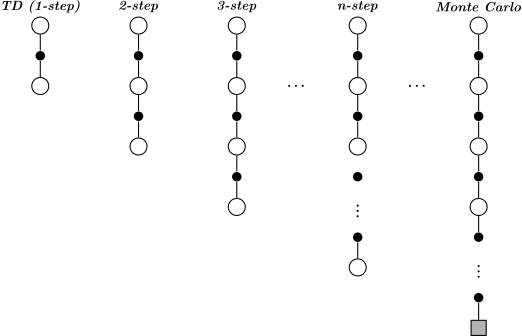
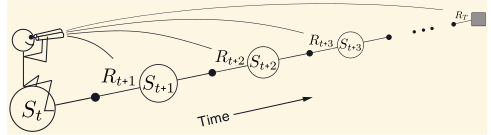
\(n\)-Step SARSA (Bias-variance trade-off)

Consider the following \(n\)-step returns for \(n = 1, 2, \infty\):

\[\begin{align*} {\color{red}{n}} & {\color{red}{= 1\ \ \ \ \ \text{(SARSA)}}} & q_t^{(1)} & = R_{t+1} + \gamma Q(S_{t+1})\\[0pt] {\color{red}{n}} & {\color{red}{= 2}} & q_t^{(2)} & = R_{t+1} + \gamma R_{t+2} + \gamma^2 Q(S_{t+2})\\[0pt] & {\color{red}{\vdots}} & & \vdots \\[0pt] {\color{red}{n}} & {\color{red}{= \infty\ \ \ \ \text{(MC)}}} & q_t^{(\infty)} & = R_{t+1} + \gamma R_{t+2} + \ldots + \gamma^{T-1} R_T \end{align*}\]

Define the \(n\)-step Q-return:

\[ q_t^{(n)} = R_{t+1} + \gamma R_{t+2} + \ldots + \gamma^{n-1} R_{t+n} + \gamma^n Q(S_{t+n}) \]

\(n\)-step SARSA updates \(Q(s,a)\) towards the \(n\)-step Q-return:

\[ Q(S_t, A_t) \;\leftarrow\; Q(S_t, A_t) + \alpha \Big( q_t^{(n)} - Q(S_t, A_t) \Big) \]

  • \(n=1\):    high bias, low variance

  • \(n=\infty\): no bias, high variance

Forward View SARSA(\(\lambda\))


We can do the same thing for control as we did in model-free prediction:

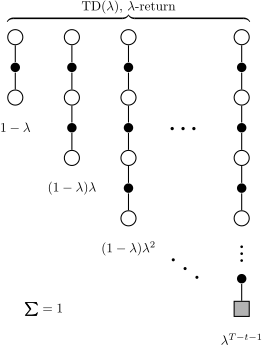
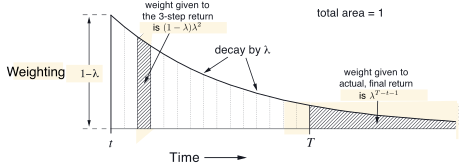
The \(q^\lambda\) return combines all \(n\)-step Q-returns \(q_t^{(n)}\)

Using weight \((1 - \lambda)\lambda^{n-1}\):

\[ q_t^\lambda \;=\; (1 - \lambda) \sum_{n=1}^{\infty} \lambda^{n-1} q_t^{(n)} \]

Forward-view SARSA(\(\lambda\)):

\[ Q(S_t, A_t) \;\leftarrow\; Q(S_t, A_t) + \alpha \Big( q_t^\lambda - Q(S_t, A_t) \Big) \]

Backward View SARSA(\(\lambda\))

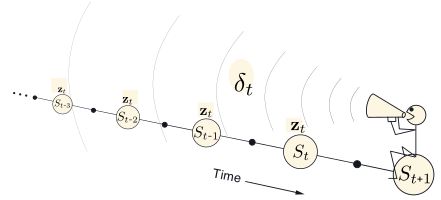
Just like TD(\(\lambda\)), we use eligibility traces in an online algorithm

  • However SARSA(\(\lambda\)) has one eligibility trace for each state–action pair

\[\begin{align*} E_0(s,a) & = 0 \\[0pt] E_t(s,a) & = \gamma \lambda E_{t-1}(s,a) + \mathbf{1}(S_t = s, A_t = a) \end{align*}\]

\(Q(s,a)\) is updated for every state \(s\) and action \(a\)

  • In proportion to TD-error \(\delta_t\) and eligibility trace \(E_t(s,a)\)

\[ \delta_t = R_{t+1} + \gamma Q(S_{t+1}, A_{t+1}) - Q(S_t, A_t) \]

\[ Q(s,a) \;\leftarrow\; Q(s,a) + \alpha \,\delta_t \, E_t(s,a) \]

SARSA(\(\lambda\)) Algorithm

SARSA(\(\lambda\))

Initialise \(Q(s,a)\) arbitrarily, \(\forall s \in \mathcal{S}, a \in \mathcal{A}(s)\)
Loop for each episode:
    \(E(s,a) = 0\), for all \(s \in \mathcal{S}, a \in \mathcal{A}(s)\)
    Initialise \(S, A\)
    Loop for each step of episode:
        Take action \(A\), observe \(R, S'\)
        Choose \(A'\) from \(S'\) using policy derived from \(Q\) (e.g., \(\varepsilon\)-greedy)
        \(\delta \;\leftarrow\; R + \gamma Q(S',A') - Q(S,A)\)
        \(E(S,A) \;\leftarrow\; E(S,A) + 1\)
        For all \(s \in \mathcal{S}, a \in \mathcal{A}(s)\):
            \(Q(s,a) \;\leftarrow\; Q(s,a) + \alpha \,\delta \, E(s,a)\)
            \(E(s,a) \;\leftarrow\; \gamma \lambda E(s,a)\)
         \(S \;\leftarrow\; S'\) ; \(A \;\leftarrow\; A'\)
until \(S\) is terminal

Algorithm updates all action-state pairs \(Q(s,a)\) at each step of an episode

SARSA(\(\lambda\)) Gridworld Example

                                                                              SARSA(0)                                                 SARSA(\(\lambda\))

  • Assume initialise action-values to zero

  • Size of arrow indicates magnitude of \(Q(A,S)\) value for that state

  • SARSA updates all action-state pairs \(Q(s,a)\) at each step of episode

Off-Policy Learning

Off-Policy Learning

Evaluate target policy \(\pi(a \mid s)\) to compute \(v_\pi(s)\) or \(q_\pi(s,a)\)
while following a behaviour policy \(\mu(a \mid s)\)

\[ \{ S_1, A_1, R_2, \ldots, S_T \} \sim \mu \]

Why is this important?

  • Learning from observing humans or other agents (either AI or simulated)

  • Re-use experience generated from old policies \({\pi_1, \pi_2, \ldots, \pi_{t-1}}\)

  • Learn about optimal policy while following exploratory policy

  • Learn about multiple policies while following one policy

Importance Sampling

Estimate the expectation of a different distribution

\[\begin{align*} \mathbb{E}_{X \sim P}[f(X)] \;& =\; \sum P(X) f(X)\\[0pt] & = \sum Q(X) \, \frac{P(X)}{Q(X)} f(X)\\[0pt] & = \mathbb{E}_{X \sim Q} \!\left[ \frac{P(X)}{Q(X)} f(X) \right] \end{align*}\]

A technique for estimating expectations by sampling from different distributions

  • Re-weights by dividing and multiplying samples to correct mismatch between expectations of the different distributions

Importance Sampling for Off-Policy Monte-Carlo

Use returns generated from \(\mu\) to evaluate \(\pi\)

  • Weight return \(G_t\) according to similarity between policies

  • Multiply importance sampling corrections along entire episode

\[ G_t^{\pi / \mu} = \frac{\pi(A_t \mid S_t)}{\mu(A_t \mid S_t)} \frac{\pi(A_{t+1} \mid S_{t+1})}{\mu(A_{t+1} \mid S_{t+1})} \cdots \frac{\pi(A_T \mid S_T)}{\mu(A_T \mid S_T)} G_t \]

Updates values towards corrected return

\[ V(S_t) \;\leftarrow\; V(S_t) + \alpha \Big( {\color{red}{G_t^{\pi / \mu}}} - V(S_t) \Big) \]

  • Cannot use if \(\mu\) is zero when \(\pi\) is non-zero

  • However, importance sampling dramatically increases variance, in case of Monte-Carlo learning

Importance Sampling for Off-Policy TD

Use TD targets generated from \(\mu\) to evaluate \(\pi\)

  • Weight TD target \(R + \gamma V(S')\) by importance sampling

Only need a single importance sampling correction

\[ V(S_t) \;\leftarrow\; V(S_t) \;+\; \alpha \Bigg( {\color{red}{ \frac{\pi(A_t \mid S_t)}{\mu(A_t \mid S_t)} \Big( R_{t+1} + \gamma V(S_{t+1}) \Big)}} - V(S_t) \Bigg) \]

  • Much lower variance than Monte Carlo importance sampling (policies only need to be similar over a single step)

  • In practice you have to use TD learning when working off-policy (it becomes imperative to bootstrap)

Q-Learning

We now consider off-policy learning of action-values, \(Q(s,a)\)

No importance sampling is required using action-values as you can bootstrap as follows

  • Next action is chosen using behaviour policy \(A_{t+1} \sim \mu(\cdot \mid S_t)\)

  • But we consider alternative successor action \(A^{\prime} \sim \pi(\cdot \mid S_t)\)

  • \(\cdots\) and we update \(Q(S_t, A_t)\) towards value of alternative action

\[ Q(S_t, A_t) \;\leftarrow\; Q(S_t, A_t) + \alpha \Big( {\color{red}{R_{t+1} + \gamma Q(S_{t+1}, A')}} - Q(S_t, A_t) \Big) \]

Q-learning is the technique that works best with off-policy learning

Off-Policy Control with Q-Learning

We can now allow both behaviour and target policies to improve

  • The target policy \(\pi\) is greedy w.r.t. \(Q(s,a)\)

\[ \pi(S_{t+1}) = \arg\max_{a'} Q(S_{t+1}, a') \]

  • The behaviour policy \(\mu\) is e.g. \(\varepsilon\)-greedy w.r.t. \(Q(s,a)\)

The Q-learning target then simplifies according to:

\[\begin{align*} & R_{t+1} + \gamma Q(S_{t+1}, A')\\[0pt] = & R_{t+1} + \gamma Q\big(S_{t+1}, \arg\max_{a'} Q(S_{t+1}, a')\big)\\[0pt] = & R_{t+1} + \max_{a'} \gamma Q(S_{t+1}, a') \end{align*}\]

Q-Learning Control Algorithm

\[ Q(S,A) \;\leftarrow\; Q(S,A) + \alpha \Big( R + \gamma \max_{a'} Q(S',a') - Q(S,A) \Big) \]

Theorem

Q-learning control converges to the optimal action–value function, \(Q(s,a) \;\to\; q_{*}(s,a)\)

Q-Learning Algorithm for Off-Policy Control

\(Q-\)Learning (Off-Policy)

Initialise \(Q(s,a)\), \(\forall s \in \mathcal{S}, a \in \mathcal{A}(s)\), arbitrarily, and \(Q(\text{terminal-state}, \cdot) = 0\)
Loop for each episode:
    Initialise \(S\)
    Loop for each step of episode:
        Choose \(A\) from \(S\) using policy derived from \(Q\) (e.g., \(\varepsilon\)-greedy)
        Take action \(A\), observe \(R, S'\)
        \(Q(S,A) \;\leftarrow\; Q(S,A) + \alpha \Big[ R + \gamma \max_a Q(S',a) - Q(S,A) \Big]\)
        \(S \;\leftarrow\; S'\)
until \(S\) is terminal

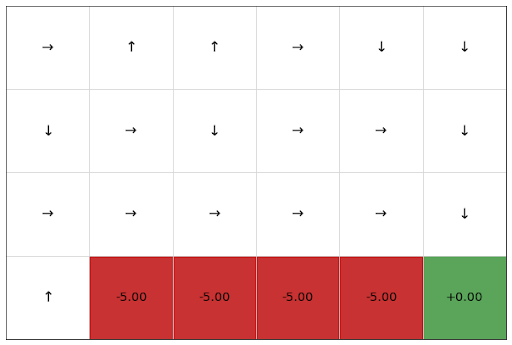
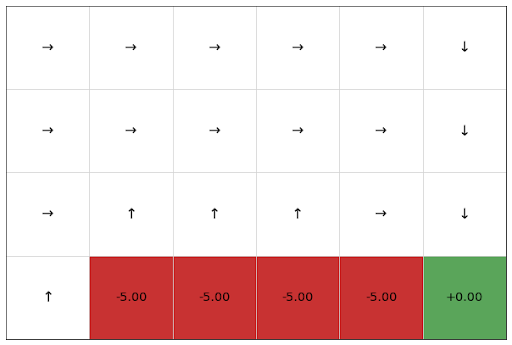
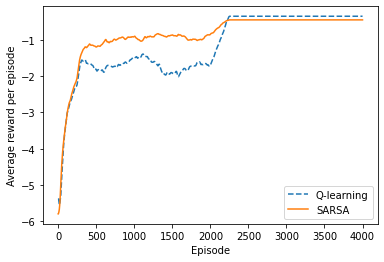
Cliff Walking Example (SARSA versus Q-Learning)

Relationship between Tree Backup and TD

Relationship between DP and TD


Dynamic Programming (DP) Sample Backup (TD)
Iterative Policy Evaluation
\(V(s) \;\leftarrow\; \mathbb{E}[R + \gamma V(S') \mid s]\)
TD Learning
\(V(S) \;\xleftarrow{\;\alpha\;}\; R + \gamma V(S')\)
Q-Policy Iteration
\(Q(s,a) \;\leftarrow\; \mathbb{E}[R + \gamma Q(S',A') \mid s,a]\)
SARSA
\(Q(S,A) \;\xleftarrow{\;\alpha\;}\; R + \gamma Q(S',A')\)
Q-Value Iteration
\(Q(s,a) \;\leftarrow\; \mathbb{E}\!\left[R + \gamma \max_{a' \in \mathcal{A}} Q(S',a') \;\middle|\; s,a \right]\)
Q-Learning
\(Q(S,A) \;\xleftarrow{\;\alpha\;}\; R + \gamma \max_{a' \in \mathcal{A}} Q(S',a')\)

where \(x \;\xleftarrow{\;\alpha\;} y \;\;\equiv\;\; x \;\leftarrow\; x + \alpha \,(y - x)\)

Reference Topics

See the Appendix for details of Convergence & Contraction Mapping Theorem, and the relationship between Forward and Backward TD.