02 Search Algorithms
State Model for Classical Planning
State Model: Classical Planning
State Model \(\mathcal{S}(P)\):
- finite and discrete state space \(S\)
- a known initial state \(s_{0} \in S\)
- a set \(\textstyle S_G \subseteq S\) of goal states
- actions \(A(s) \subseteq A\) applicable in each \(s \in S\)
- a deterministic transition function \(s' = f(a, s)\) for \(a \in A(s)\)
- positive action costs \(c(a, s)\)
A solution is a sequence of applicable actions that maps \(s_0\) into \(S_G\), and it is optimal if it minimizes sum of action costs (e.g., # of steps)
Different models and controllers obtained by relaxing assumptions in blue …
Solving the State Model: Path-finding in graphs
Search algorithms for planning exploit the correspondence between classical state models \(\mathcal{S}(P)\) and directed graphs:
- The nodes of the graph represent the states \(s\) in the model
- The edges \((s, s')\) capture corresponding transitions in the model with the same cost
In the planning as heuristic search formulation, the problem \(P\) is solved by path-finding algorithms over the graph associated with model \(\mathcal{S}(P)\)
Classification of Search Algorithms
Blind search vs. heuristic (or informed) search:
- Blind search algorithms: Only use the basic ingredients for general search algorithms.
- e.g., Depth First Search (DFS),
- Breadth-first Search (BrFS),
- Uniform Cost (Dijkstra), and
- Iterative Deepening (ID)
- Heuristic search algorithms: Additionally use heuristic functions which estimate the distance (or remaining cost) to the goal.
- e.g., A\(^*\), IDA\(^*\), Hill Climbing, Best First, WA\(^*\), DFS B&B, LRTA\(^*\), …
Classification of Search Algorithms (continued)
Systematic search vs. local search:
Systematic search algorithms: Considers a large number of search nodes simultaneously; maintains an explicit frontier or open list of states still to explore, and often also a closed list of visited states.
Local search algorithms: Local search usually keeps just one current state (or a small number), and repeatedly moves to a neighbouring state that seems better according to an evaluation function.
This is not a black-and-white distinction; there are crossbreeds (e.g., enforced hill-climbing).
What works where in planning?
Blind search vs. heuristic search:
- For satisficing planning, heuristic search vastly outperforms blind algorithms pretty much everywhere.
- For optimal planning, heuristic search also is better (but the difference is less pronounced).
Systematic search vs. local search:
- For satisficing planning, there are successful instances of each.
- For optimal planning, systematic algorithms are required.
We cover a subset of search algorithms most successful in planning. Only some blind search algorithms are covered (refer to Russel & Norvig Chapters 3 and 4).
Search terminology
- Search node \(n\): Contains a state reached by the search, plus information about how it was reached.
- Path cost \(g(n)\): The cost of the path reaching \(n\).
- Optimal cost \(g^*\): The cost of an optimal solution path. For a state \(s\), \(g^*(s)\) is the cost of a cheapest path reaching \(s\).
- Node expansion: Generating all successors of a node, by applying all actions applicable to the node’s state \(s\). Afterwards, the state \(s\) itself is also said to be expanded.
- Search strategy: Method for deciding which node is expanded next.
- Open list: Set of all nodes that currently are candidates for expansion. Also called frontier.
- Closed list: Set of all states that were already expanded. Used only in graph search, not in tree search (up next). Also called explored set.
World States versus Search States
Search Space for Classical Search
A classical search space is defined by the following three operations:
- \(\text{start}()\): Generate the start (search) state.
- \(\text{is-goal}(s)\): Test whether a given search state is a target (goal) state.
- \(\text{succ}(s)\): Generates the successor states \((a, s')\) of search state \(s\), along with the actions through which they are reached.
Search states \(\neq\) world states?
- Progression (forward reasoning from initial state)?:
Yes, search states = world states.
- Regression (backwards reasoning from goal)?::
No, search states \(\neq\) world states, in fact search states = sets of world states represented as conjunctive sub-goals.
We consider progression in the entire course, unless explicitly stated otherwise.
We use ‘\(s\)’ to denote world and search states interchangeably
Search States versus Search Nodes
- Search states \(s\): are states (vertices) of the search space.
- Search nodes \(\sigma\): are search states, plus information on where/when/how they are encountered during search (i.e. bookkeeping information).
What is in a search node?
Different search algorithms store different information in a search node \(\sigma\), but typical information includes:
- \(\text{state}(\sigma)\): Associated search state.
- \(\text{parent}(\sigma)\): Pointer to search node from which \(\sigma\) is reached.
- \(\text{action}(\sigma)\): An action leading from \(\text{state}(\text{parent}(\sigma))\) to \(\text{state}(\sigma)\).
- \(g(\sigma)\): Cost of \(\sigma\) (cost of path from the root node to \(\sigma\)).
For the root node, \(\text{parent}(\sigma)\) and \(\text{action}(\sigma)\) are undefined.
Criteria for Evaluating Search Strategies
Guarantees:
- Completeness: Is the strategy guaranteed to find a solution when there is one?
- Optimality: Are the returned solutions guaranteed to be optimal?
Computational Complexity:
- Time Complexity: How long does it take to find a solution? (Measured in generated states.)
- Space Complexity: How much memory does the search require? (Measured in states.)
Typical state space features governing complexity:
- Branching factor \(b\): How many successors does each state have?
- Goal depth \(d\): The number of actions required to reach the shallowest goal state.
Blind Systematic Search
Blind search versus Informed search
Blind search does not require any input beyond the problem.
Pros and Cons?
Pros: No additional work for the programmer.
Cons: It’s not called “blind” for nothing … it uses the same expansion order regardless what the problem actually is; it is rarely effective in practice.
Compare with Informed search, which requires as additional input of a heuristic function \(h\) (we will cover in next module) that maps states to estimates of their goal distance.
Pros and Cons?
Pro: Typically more effective in practice.
Con: Requires coming up with and implementation of \({\color{blue}h}\).
In classical planning, \(h\) is generated automatically from the declarative problem description.
Blind search strategies we will cover
Blind search strategies we’ll cover:
Breadth-first search. Advantage: time complexity.
Variant: Uniform cost search.
Depth-first search. Advantage: space complexity.
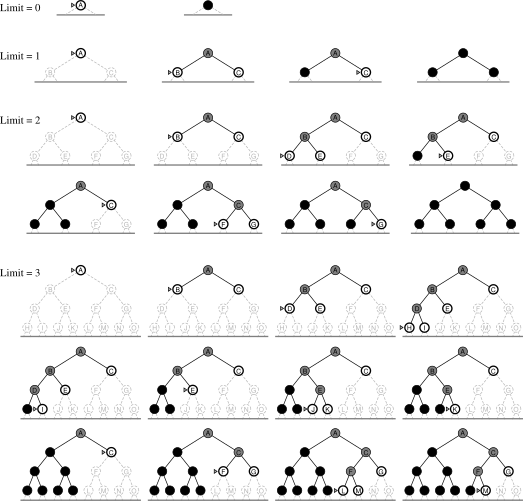
Iterative deepening search. Combines advantages of breadth-first search and depth-first search. Uses depth-limited search as a sub-procedure.
Width-based search, in particular Iterated Width (IW)
Blind search strategy we won’t cover:
- Bi-directional search. Two separate search spaces, one forward from the initial state, the other backward from the goal. Stops when the two search spaces overlap.
Breadth-First Search: Illustration and Guarantees
Strategy: Expand nodes in the order they were produced (FIFO frontier).

Guarantees?: A) Complete and optimal B) Complete but may not be optimal C) Optimal but may not be complete D) Neither complete nor optimal
- Completeness? Yes.
- Optimality? Yes, for uniform action costs. Breadth-first search always finds a shallowest goal state. If costs are not uniform, it is not necessarily optimal.
Breadth-First Search: Time Complexity
Say that \(b\) is the maximal branching factor, and \(d\) is the goal depth (depth of the shallowest goal state).
What is the upper bound on the number of generated nodes?
Generated nodes at each layer: \(b + b^{2} + b^{3} + \cdots + b^{d}\): In the worst case, the algorithm generates all nodes in the first \(d\) layers.
So the time complexity is \(O(b^{d})\).
And what if we were to apply the goal test at node-expansion time, rather than node-generation time?
- \(O(b^{d+1})\) because then we generate the first \(d+1\) layers in the worst case.
Breadth-First Search: Space Complexity?
Space Complexity: Same as time complexity, since all generated nodes are kept in memory.
Breadth-First Search: Example Data
Settings: \(b = 10\); \(10{,}000\) nodes/second; \(1{,}000\) bytes/node.
Yields data: by inserting values into equations from
| Depth | Nodes | Time | Memory |
|---|---|---|---|
| 2 | 110 | 0.11 ms | 107 KB |
| 4 | 11,110 | 11 ms | 10.6 MB |
| 6 | \(10^{6}\) | 1.1 s | 1 GB |
| 8 | \(10^{8}\) | 2 min | 103 GB |
| 10 | \(10^{10}\) | 3 h | 10 TB |
| 12 | \(10^{12}\) | 13 days | 1 PB |
| 14 | \(10^{14}\) | 3.5 years | 99 PB |
Which is the worse problem - time or memory?
- Memory. In practice, RAM is typically exhausted within a few minutes.
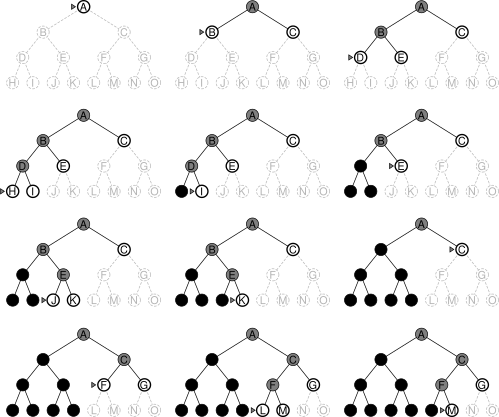
Depth-First Search: Illustration
Strategy: Expand the most recent nodes, LIFO frontier (left to right, top to bottom)
Illustration: Nodes at depth 3 are assumed to have no successors
Depth-First Search: Guarantees
Guarantees?
A) Complete and optimal
B) Complete but may not be optimal
C) Optimal but may not be complete
D) Neither complete nor optimal
Optimality? No. After all, the algorithm just chooses some direction and hopes for the best (Depth-first search is a way of “hoping to get lucky”).
Completeness? No, because search branches may be infinitely long — there is no cycle check along a branch.
Depth-first search is complete when the state space is acyclic, e.g. in constraint satisfaction problems. If we add cycle checking, it becomes complete for finite state spaces.*
Depth-First Search: Complexity
Complexity?
Space:
- Stores nodes and applicable actions on the path to the current node. If \(m\) is the maximal depth reached, the space complexity is \(O(b\,m)\).
Time:
If there are paths of length \(m\) in the state space, up to \(O(b^m)\) nodes can be generated - this can happen even if solutions exist at depth\(1\).
- If we are lucky enough to choose “the right direction”, we can find a length-\(\ell\) solution in time \(O(b\,\ell)\), regardless of how large the state space is.
Iterative Deepening Search: Illustration (by Limit)
Iterative Deepening Search: Guarantees
“Iterative Deepening Search = Keep doing the same work over again until you find a solution”
Guarantees:
Optimality? - Yes, for uniform costs.
Completeness? - Yes.
- Space complexity?
- \(O(b\,d)\).
Iterative Deepening Search: Time Complexity
Time Complexity?
| Breadth-First Search | \(b + b^{2} + \cdots + b^{d-1} + b^{d} \in {\color{blue}O(b^d)}\) |
| Iterative Deepening Search | \((d)b + (d-1)b^{2} + \cdots + 3b^{d-2} + 2b^{d-1} + 1b^{d} \in {\color{blue}O(b^d)}\) |
Example: \(b = 10,\ d = 5\)
| Breadth-First Search | \(10 + 100 + 1{,}000 + 10{,}000 + 100{,}000 = 111{,}110\) |
| Iterative Deepening Search | \(50 + 400 + 3{,}000 + 20{,}000 + 100{,}000 = 123{,}450\) |
IDS combines the advantages of breadth-first and depth-first search. It is the preferred blind search method in large state spaces with unknown solution depth.
Width-Based Search
Structure in Planning problems
Planning is computationally complex in the worst case
- PSPACE-complete (see the Appendix)
- However, current planners can solve most of the international planning competition (IPC) benchmarks in a few seconds.
Question:
Can we explain why planners perform well?
- Can we characterise the structure that separates easy from hard domains?
Answer:
A width of planning exponential in problem width goes a long way to explaining problem difficulty:
- Benchmark planning domains have small width when goals are restricted to single atoms (boolean variables or facts)
- Joint goals are easy to serialise into a sequence of single goals
Limitations of serialisation?
- Problems with high atomic width (however, apparently there are not many practical problems in this class)
- Multiple-goal problems that are not easy to serialise include, for example, the Sokoban game.
Novelty
Definition: Novelty
The novelty \(w(s)\) of a state \(s\) is the size of the smallest subset of atoms (boolean variables or facts) in \(s\) that is true for the first time in the search.
- e.g. \(w(s)=1\) if there is one atom \(p \in s\) such that \(s\) is the first state that makes \(p\) true.
- Otherwise, \(w(s)=2\) if there are two different atoms \(p, q \in s\) such that \(s\) is the first state that makes \(p \land q\) true.
- Otherwise, \(w(s)=3\) if there are three different atoms…
Iterated Width (\(IW\))
Algorithm
- \(IR(k)\) = breadth-first search that prunes newly generated states whose novelty\((s) > k\).
- \(IW\) is a sequence of calls \(IR(k)\) for \(k=0,1,2,\ldots\) over problem \(P\) until the problem is solved or \(k\) exceeds the number of variables in the problem.
Properties
\(IW(k)\) expands at most \(O(n^k)\) states, where \(n\) is the number of atoms.
Is \(IW\) good at Classical Planning?
- \(IW\), while a blind algorithm, is good on planning problems when goals are restricted to single atoms.
- The width of benchmark domains is small for such goals.
Our research group tested domains from previous International Planning Competitions (IPCs) benchmark problems.
For each instance with \(N\) goal atoms, we created \(N\) instances with a single goal.
IPC results are remarkably good:
| # Instances | \(IW\) | \(ID\) | \(BRFS\) | \(GBFS + h_{add}\) |
|---|---|---|---|---|
| 37921 | 91% | 24% | 23% | 91% |
Why does \(IW\) do so well?
Properties
For problems \(\Pi \in \mathcal{P}\) where \(width(\Pi)=k\):
- \(IW(k)\) solves \(\Pi\) in time \(O(n^k)\)
- \(IW(k)\) solves \(\Pi\) optimally for problems with uniform cost functions
- \(IW(k)\) is complete for \(\Pi\)
Theorem
Blocks, Logistics, Gripper, and \(n\)-puzzle have a bounded width independent of problem size and initial situation, provided that goals are single atoms.
In practice, \(IW(k \le 2)\) solves 88.3% of IPC problems with single goals:
| # Instances | \(k=1\) | \(k=2\) | \(k>2\) | Total |
|---|---|---|---|---|
| 37921 | 37.0% | 51.3% | 11.7% | 88.3% |
\(IW\) in Classical Planning?
Primary question: \(IW\) solves atomic (single atom) goals — how do we extend the blind procedure to multiple atomic goals?
Serialised Iterated Width (SIW)
A simple way to use \(IW\) for solving real benchmarks \(P\) with joint goals is a simple form of hill climbing over the goal set \(G\) with \(|G|=n\)
- This achieves atomic goals one at a time…
How SIW Explores State Space
IW Example: Playing Atari Games
Serialised Iterated Width (SIW) (continued)
\(SIW\) uses \(IW\) for both decomposing a problem into subproblems and solving subproblems.
It’s a blind search procedure, as \(IW\) does not even know the next goal \(G_i\) to achieve.
Blind \(SIW\) is better than \(GBFS\)
- It is even better than GBFS + the heuristic \(h_{add}\) which we will introduce in the next module
\(IW\) Overview
\(IW\): is essentially a sequence of novelty-based pruned breadth-first searches
- Experiments: excellent when goals are restricted to atomic goals
- Theory: such problems have low width \(w\), and \(IW\) runs in time \(O(n^w)\)
\(SIW\): is essentially \(IW\) serialised, used to attain top goals one-by-one
- Experiments: faster, better coverage, and much better plans than GBFS with \(h_{add}\)
- Intuition: goals are easy to [serialise]{style=“color:blue”] and have atomic low width \(w\)
Heuristic Functions
Heuristic Search Algorithms
Heuristic search algorithms are the most common and overall most successful algorithms for classical planning.
The Origins of Heuristic Search: Shakey, 1972
Heuristic search algorithms: Systematic
Greedy best-first search.
- One of the three most popular algorithms in satisficing planning
Weighted A*.
- One of the three most popular algorithms in satisficing planning
A*.
- Most popular algorithm in optimal planning (rarely ever used for satisficing planning)
IDA*, depth-first branch-and-bound search, breadth-first heuristic search, …
Heuristic search algorithms: Local
Hill-climbing.
Enforced hill-climbing.
- One of the three most popular algorithms in satisficing planning
Other algorithms include beam search, tabu search, genetic algorithms, simulated annealing, etc.
Heuristic Search: Basic Idea
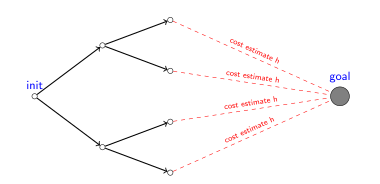
A heuristic function \(h\) estimates the cost of an optimal path to the goal
Search gives a preference to explore states with small \(h\).
Heuristic Functions
Heuristic searches require a heuristic function to estimate remaining cost
Definition: Heuristic Function
Let \(\Pi\) be a planning problem with state space \(\Theta_\Pi\).
A heuristic function, or heuristic, for \(\Pi\) is a function \(h : S \mapsto \mathbb{R}^+_0 \cup \{\infty\}\)
Its value \(h(s)\) for state \(s\) is referred to as the state’s heuristic value, or just \(h\)-value
Definition: Remaining Cost, \(h^{*}\)
Let \(\Pi\) be a planning problem with state space \(\Theta_\Pi\).
For a state \(s \in S\), the state’s remaining cost is the cost of an optimal plan for \({\color{blue}s}\), or \({\color{blue}\infty}\) if there exists no plan for \(s\).
The perfect heuristic for \(\Pi\), written \(\color{blue}{h^{*}}\), assigns every \(s \in S\) its remaining cost as the heuristic value.
Heuristic Functions: Discussion
What does it mean to estimate remaining cost?
For many heuristic search algorithms, \(h\) does not need to have any properties for the algorithm to work (meaning being correct and complete).
- \(h\) is any function from states to numbers…
Search performance depends crucially on how well \(h\) reflects \(h^{*}\)
- This is informally called the informedness or quality of \(h\).
For some search algorithms, such as \(A^{*}\), the relationship between formal quality properties of \(h\) and search efficiency can be proven (number of expanded nodes).
For other search algorithms, “it works well in practice” is often as good an analysis as one gets.
We will analyse in a later Module detail approximations to one particularly important heuristic function in planning: \(h^+\).
Heuristic Functions: Discussion (continued)
- Search performance depends crucially on the informedness of \(h\)
Are there other properties of \(h\) that search performance crucially depends on?
- One important property is the computational overhead of computing \(h\)
What about edge cases?
- \(h=h^*\): Perfectly informed; however computing it = solving the planning problem in the first place!
- \(h=0\): No information at all; can be “computed” in constant time.
Trade-off: informedness versus computational overhead
A successful heuristic search requires a good trade-off between \(h\)’s informedness and the computational overhead of computing it.
- This involves engineering methods that yield good estimates at reasonable computational costs.
Important Properties of Heuristic Functions
Definition: Heuristic Function Properties
Let \(\Pi\) be a planning problem with state space \(\Theta_\Pi=(S,L,c,T,I,S^G)\), and let \(h\) be a heuristic for \(\Pi\).
- \(h\) is safe if for all \(s \in S, h(s) = \infty\ \Longrightarrow\ h^*(s) = \infty\)
- \(h\) is goal-aware if \(h(s)=0\) for all goal states \(s\in S^G\)
- \(h\) is admissible if \(h(s)\le h^*(s)\) for all \(s\in S\)
- \(h\) is consistent if \(h(s)\le h(s') + c(a)\) for all transitions \(s \xrightarrow{a} s'\)
- Note that \(h^*(s)\) is the perfect heuristic for state \(s\) (optimal cost-to-go), and \(h(s)\) is the value actually returned by the heuristic function.
- \(T\) is the transition relation which specifies which successor states can be reached from which states under which action and \(L\) are the action or operator labels.
Relationships between properties of Heuristic Functions
What are the relationship between these properties?
- safety (never discard a state that could lead to a valid solution)
- goal-awareness (assigns \(0\) to every goal state)
- admissibility (never over estimates true cost to a goal)
- consistency (recognises triangle inequality over transitions)
- If \(h\) is consistent and goal-aware, then \(h\) is admissible.
- If \(h\) is admissible, then \(h\) is goal-aware.
- If \(h\) is admissible, then \(h\) is safe. No other implications of this form hold.
- Proof. Exercise.
Informed Systematic Search
Greedy Best-First Search
Greedy Best-First Search (with duplicate detection)
\(open :=\) new priority queue ordered by ascending \(h(state(\sigma))\)
\(open.\text{insert(make-root-node}(init()))\)
\(closed := \emptyset\)
while not \(open.empty()\):
\(\sigma := open.\text{pop-min}()\) /* get best state */
if \(state(\sigma) \notin closed\): /* check for duplicates */
\(closed := closed \cup \{state(\sigma)\}\) /* add state to closed set */
if \(is\text{-}goal(state(\sigma))\): return \(\text{extract-solution}(\sigma)\)
for each \((a,s') \in succ(state(\sigma))\): /* expand state */
\(\sigma' := \text{make-node}(\sigma,a,s')\)
if \(h(state(\sigma')) < \infty\): \(open.\text{insert}(\sigma')\)
return unsolvable
Greedy Best-First Search: Properties
Completeness?
- Yes, for safe heuristics (and duplicate detection to avoid cycles).
Optimality?
No. Even for perfect heuristics!
- E.g., suppose the start state has two transitions to goal states, one costing a million dollars and the other free. Nothing prevents Greedy Best-First Search from choosing the bad one, as for a perfect heuristic \(h(s_g)=0\), and GBFS looks only at how close a successor seems to the goal (not at how much it cost to get there).
Invariant under all strictly monotonic transformations of \(h\) (e.g., scaling by a positive constant or adding a constant).
Greedy Best-First Search: Implementation as \(A^*\) variant
Depending upon where you do duplicate detection in the Greedy Best First Search (GBFS) loop, it can make GBFS appear as an A\(^*\) variant as follows:
- A priority queue can be implemented as a min heap
- A min-heap is a data structure for a priority queue where the smallest key is always quick to access.
- Duplicate detection can be done at the state expansion stage of A\(^*\)
- Checking duplicates can be done following getting the best state
\(A^{*}\) (GBFS variant)
\(A^*\) (with duplicate detection and re-opening)
\(\textit{open} :=\) new priority queue ordered by ascending \(g(state(\sigma)) + h(state(\sigma))\)
\(\textit{open}\text{.insert(make-root-node}({\color{blue}\text{init}()}))\)
\(closed := \emptyset\)
\(best\text{-}g := \emptyset\) /* maps states to non-negative real numbers */
while not \(\textit{open}.\text{empty}()\):
\(\sigma := open.\text{pop-min}()\)
if \(state(\sigma) \notin closed\) or \(g(\sigma) < best\text{-}g(state(\sigma))\):
/* Check duplicates: re-open if better \(g\) (note that all \(\sigma'\) with same state but worse \(g\)
are behind \(\sigma\) in \(open\), and will be skipped when their turn comes) */
\(closed := closed \cup \{state(\sigma)\}\)
\(best\text{-}g(state(\sigma)) := g(\sigma)\)
if \({\color{blue}\text{is-goal}}(state(\sigma))\): return \(extract\text{-}solution(\sigma)\)
for each \((a,s') \in {\color{blue}\text{succ}}(state(\sigma))\):
\(\sigma' := \text{make-node}(\sigma,a,s')\)
if \(h(state(\sigma')) < \infty\): \(open.insert(\sigma')\)
return unsolvable
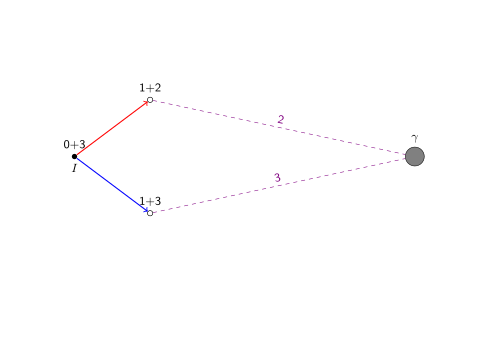
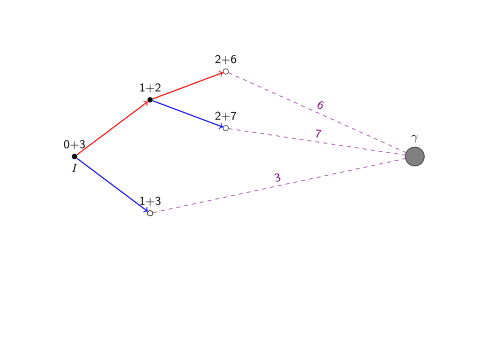
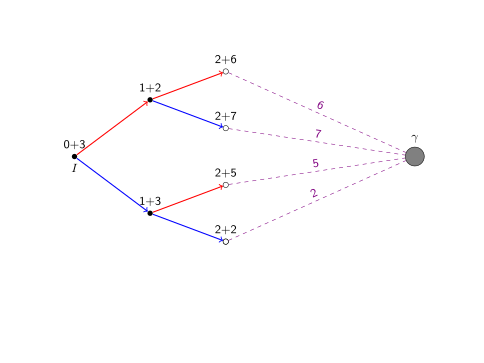
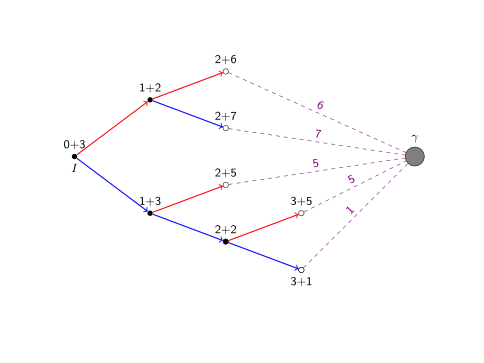
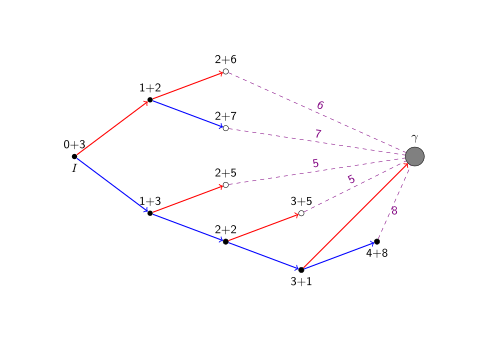
\(A^{*}\) (The normal variant): Example

\(A^{*}\): Terminology
\(f\)-value of a state: defined by \(f(s) = g(s) + h(s)\).
Generated nodes: Nodes inserted into \(open\) priority queue at some point.
Expanded nodes: Nodes \(\sigma\) popped from \(open\) priority queue, for which the test against the \(closed\) set and the distance succeeds.
Re-expanded nodes: Expanded nodes for which \(state(\sigma) \in closed\) upon expansion (also called re-opened nodes).
\(A^{*}\): Properties
Completeness?
- Yes, for safe heuristics (even without duplicate detection.)
Optimal?
- Yes, for admissible heuristics (even without duplicate detection.)
\(A^{*}\): Implementation Considerations
- A popular method is to break ties, in the event that \(f(s_1) = f(s_2)\), by choosing the node with the smaller \(h\)-value.
- If \(h\) is admissible and consistent, then \(A^*\) never re-opens a state. So if we know that this is the case, we can simplify the algorithm.
- A common, and hard-to-spot bug is as follows: checking duplicates at the wrong point in the algorithm (note that the Russell & Norvig text is not very precise about this).
- Note that the implementation shown in this Module is optimised for readability, not for efficiency!
Question?
Question
If we set \(h(s) := 0\) for all \(s\), what does \(A^{*}\) become?
(A) Breadth-first search
(C) Uniform-cost search
(B) Depth-first search
(D) Depth-limited search
Recall that uniform-cost search is essentially Dijkstra (a best-first search that always expands the frontier node with the lowest path cost so far).
- Answer: (C)
- Same expansion order (although details in book-keeping of open/closed states may differ)
Weighted \(A^{*}\)
Weighted \(A^*\) (with duplicate detection and re-opening)
\(open :=\) new priority queue ordered by ascending \(g(state(\sigma)) + {\color{blue}W}\, h(state(\sigma))\)
\(open.\text{insert(make-root-node}({\color{blue}init()}))\)
\(closed := \emptyset\)
\(best\text{-}g := \emptyset\)
while not \(open.\text{empty}()\):
\(\sigma := open.\text{pop-min}()\)
if \(state(\sigma) \notin closed\) or \(g(\sigma) < best\text{-}g(state(\sigma))\):
\(closed := closed \cup \{state(\sigma)\}\)
\(best\text{-}g(state(\sigma)) := g(\sigma)\)
if \(is\text{-}goal(state(\sigma))\): return \(\text{extract-solution}(\sigma)\)
for each \((a,s') \in succ(state(\sigma))\):
\(\sigma' := \text{make-node}(\sigma,a,s')\)
if \(h(state(\sigma')) < \infty\): \(open.\text{insert}(\sigma')\)
return unsolvable
Weighted \(A^{*}\): Properties
The weight \(W \in \mathbb{R}^+_0\) is an algorithm parameter:
- For \(W = 0\), weighted \(A^*\) behaves like uniform-cost search.
- For \(W = 1\), weighted \(A^*\) behaves like \(A^*\).
- For \(W \to \infty\), weighted \(A^*\) behaves like greedy best-first search.
For \(W > 1\), weighted \(A^*\) is bounded suboptimal\(^*\)
- if \(h\) is admissible, then the solutions returned are at most a factor \(W\) more costly than the optimal ones.
\({\color{blue}^*}\)Bounded suboptimal means that the algorithm may return a non-optimal solution, and there’s a proven bound on how much worse it can be than optimal.
Local Search Algorithms
Hill-Climbing
Hill-Climbing
\(\sigma := make\text{-}root\text{-}node(init())\)
forever:
if \(is\text{-}goal(state(\sigma))\):
return \(extract\text{-}solution(\sigma)\)
\(\Sigma' := \{\, make\text{-}node(\sigma,a,s') \mid (a,s') \in {\color{blue}succ}(state(\sigma)) \,\}\)
\(\sigma :=\) choose an element of \(\Sigma'\) minimising \(h\) \({\color{blue}\text{/* random tie breaking */}}\)
- Makes sense only if \(h(s) > 0\) for \(s \notin S^G\) (i.e. all non-goal states have a positive heuristic)
Is this complete or optimal?
- No
- Can easily get stuck in local minima where immediate improvements of \(h(\sigma)\) are not possible.
- There are many variations: tie-breaking strategies, restarts, etc.
Enforced Hill-Climbing
Enforced Hill-Climbing: Procedure \(improve\)
def \(improve(\sigma_0):\)
\(queue :=\) new FIFO queue
\(queue.\text{push-back}(\sigma_0)\)
\(closed := \emptyset\)
while not \(queue.\text{empty}()\):
\(\sigma := queue.\text{pop-front}()\)
if \(state(\sigma) \notin closed\):
\(closed := closed \cup \{state(\sigma)\}\)
if \(h(state(\sigma)) < h(state(\sigma_0))\): return \(\sigma\) /* If better state is found return it */
for each \((a,s') \in {\color{blue}succ}(state(\sigma))\):
\(\sigma' := \text{make-node}(\sigma,a,s')\)
\(queue.\text{push-back}(\sigma')\)
fail
Is essentially breadth-first search for a state with strictly smaller \(h\)-value
- Keep hill climbing, but when stuck, systematically search outward until you find an improvement (less easily gets stuck)
Enforced Hill-Climbing
\(\sigma := make\text{-}root\text{-}node(init())\)
while not \(is\text{-}goal(state(\sigma))\):
\(\sigma := improve(\sigma)\)
return \(extract\text{-}solution(\sigma)\)
Is enforced hill-climbing optimal?
- No.
- Makes sense only if \(h(s) > 0\) for \(s \notin S^G\)
Is enforced hill-climbing complete?
In general, no. Under particular circumstances, yes. Assumes that \(h\) is goal-aware.
Procedure \(improve\) fails: no state with strictly smaller \(h\)-value reachable from \(s\), thus (with assumption) goal not reachable from \(s\).
This cannot happen, for example, if the state space is undirected, i.e., if for all transitions \(s \rightarrow s'\) in \(\Theta_{\Pi}\) there is a transition \(s' \rightarrow s\).
Properties of Search Algorithms
| DFS | BrFS | ID | \(A^*\) | HC | IDA* | IW | |
|---|---|---|---|---|---|---|---|
| Complete | No | Yes | Yes | Yes | No | Yes | No |
| Optimal | No | Yes\(^*\) | Yes | Yes | No | Yes | No |
| Time | \(\infty\) | \(b^d\) | \(b^d\) | \(b^d\) | \(\infty\) | \(b^d\) | \(b \cdot n^k\) |
| Space | \(b \cdot d\) | \(b^d\) | \(b \cdot d\) | \(b^d\) | \(b\) | \(b \cdot d\) | \(n^k\) |
- Parameters: \(d\) is solution depth; \(b\) is branching factor (number of applicable actions)
- Breadth-first search (BrFS) is optimal when costs are uniform.
- \(A^*\)/\(IDA^*\) are optimal when \(h\) is admissible, i.e., \(h \le h^*\)
- For IW, \(n\) is the number of features and \(k\) is the width parameter.
Conclusion
Questions
Question (Revisited)
If we set \(h(s) := 0\) for all \(s\), what does \(A^{*}\) become?
(A) Breadth-first search
(C) Uniform-cost search
(B) Depth-first search
(D) Depth-limited search
Answer: (C): Same expansion order (details in book-keeping of open/closed states may differ)
Question
If we set \(h(s) := 0\) for all \(s\), what does greedy best-first search become?
(A) Breadth-first search
(C) Uniform-cost search
(B) Depth-first search
(D) A), B) and C)
\(h\) implies no ordering of nodes at all, so this fully depends on how we break ties in the open list. (A): FIFO, (B): LIFO, (C): Order on \(g\). (Details in bookkeeping of open/closed states may differ.)
Question
Is informed search always better than blind search?
(A): Yes.
(B): No.
Answer: (A): Yes and (B): No.
In greedy best-first search, the heuristic may yield larger search spaces than uniform-cost search. E.g., in path planning, say you want to go from Melbourne to Sydney, but \(h(\)Perth\() < h(\)Canberra\()\).
In \(A^{*}\) with an admissible heuristic and duplicate checking, we cannot do worse than uniform-cost search: \(h(s) > 0\) can only reduce the number of states we must consider to prove optimality.
Also, in the above example, doesn’t expand Perth with any admissible heuristic, because \(g(\)Perth\() > g(\)Sydney\()\)!
“Trusting the heuristic” has its dangers! Sometimes \(g\) helps to reduce search.
Summary
Distinguish: World states, search states, search nodes.
World state: Situation in the world modelled by the planning problem.
Search state: Subproblem remaining to be solved.
- In progression, world states and search states are identical.
- In regression, search states are sub-goals describing sets of world states.
- In progression, world states and search states are identical.
Search node: Search state + information on “how we got there”.
Search algorithms mainly differ in order of node expansion:
- Blind vs. heuristic (or informed) search.
- Systematic vs. local search.
Search strategies differ in the order in which they expand search nodes, and in the way they use duplicate elimination.
Criteria for evaluating them include completeness, optimality, time complexity, and space complexity.
Breadth-first search is optimal but uses exponential space;
Depth-first search uses linear space but is not optimal;
Iterative deepening search combines the virtues of both.
Heuristic Functions are estimators for remaining cost.
- Usually, the more informed the search is, the better the performance.
- Desiderata includes safety, goal-awareness, admissibility, and consistency.
- The ideal is a perfect heuristic \(h^*\).
Heuristic Search Algorithms:
- Most common algorithms for satisficing planning are:
- Greedy best-first search
- Weighted \(A^*\)
- Enforced hill-climbing
- Most common algorithm for optimal planning are:
- \(A^*\)
Additional Reading
- Artificial Intelligence: A Modern Approach, Russell and Norvig (Third Edition)
- An overview of various search algorithms, including blind searches as well as greedy best-first search and \(A^*\).
- See Chapter 3: “Solving Problems by Searching” and the first half of Chapter 4: “Beyond Classical Search”.
- Search tutorial in the context of path-finding: http://www.redblobgames.com/pathfinding/a-star/introduction.html