04 Delete Relaxation
Relaxing the World by Ignoring Delete Lists
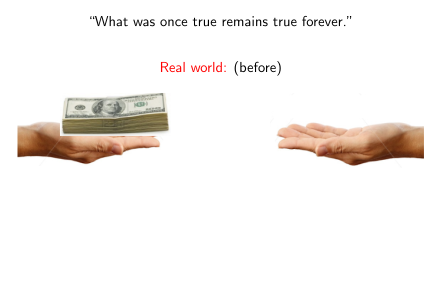
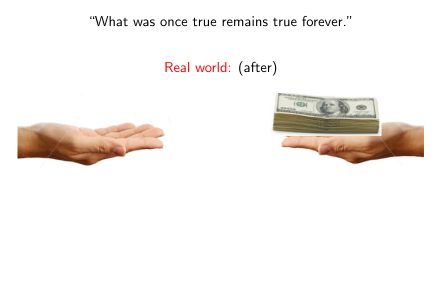
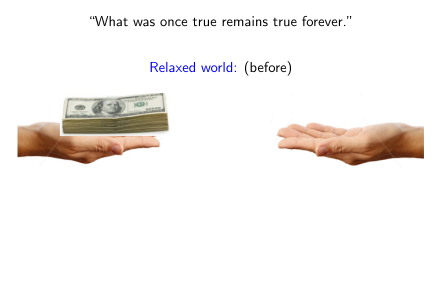
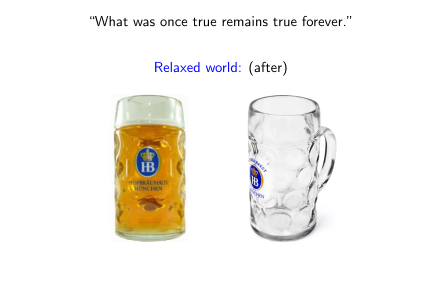
“What was once true remains true forever”
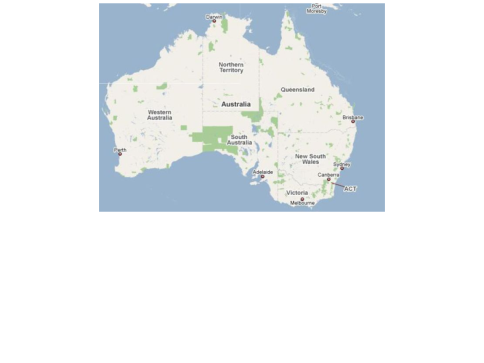
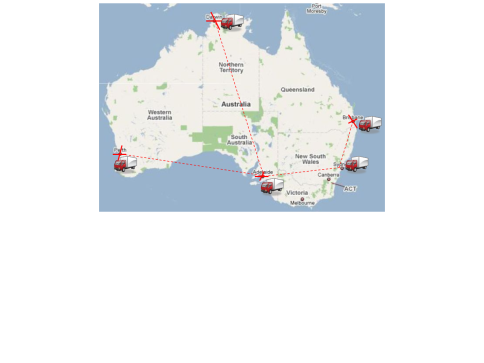
A Relaxed Plan for “TSP” in Australia

Initial state: \(\{\mathit{at}(\mathit{Sy}), \mathit{v}(\mathit{Sy})\}\)
Apply \(\mathit{drive}(\mathit{Sy},\mathit{Br})^+\): \(\{\mathit{at}(\mathit{Br}), \mathit{v}(\mathit{Br}),\) \(\mathit{at}(\mathit{Sy}), \mathit{v}(\mathit{Sy})\}\)
Apply \(\mathit{drive}(\mathit{Sy},\mathit{Ad})^+\): \(\{\mathit{at}(\mathit{Ad}), \mathit{v}(\mathit{Ad}),\) \(\mathit{at}(\mathit{Br}), \mathit{v}(\mathit{Br}),\) \(\mathit{at}(\mathit{Sy}), \mathit{v}(\mathit{Sy})\}\)
Apply \(\mathit{drive}(\mathit{Ad},\mathit{Pe})^+\): \(\{\mathit{at}(\mathit{Pe}), \mathit{v}(\mathit{Pe}),\) \(\mathit{at}(\mathit{Ad}), \mathit{v}(\mathit{Ad}),\) \(\mathit{at}(\mathit{Br}), \mathit{v}(\mathit{Br}),\) \(\mathit{at}(\mathit{Sy}), \mathit{v}(\mathit{Sy})\}\)
Apply \(\mathit{drive}(\mathit{Ad},\mathit{Da})^+\): \(\{\mathit{at}(\mathit{Da}), \mathit{v}(\mathit{Da}),\) \(\mathit{at}(\mathit{Pe}), \mathit{v}(\mathit{Pe}),\) \(\mathit{at}(\mathit{Ad}), \mathit{v}(\mathit{Ad}),\) \(\mathit{at}(\mathit{Br}), \mathit{v}(\mathit{Br}),\) \(\mathit{at}(\mathit{Sy}), \mathit{v}(\mathit{Sy})\}\)
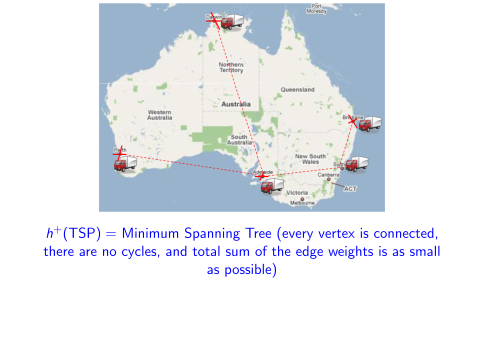
\(h^+\) in the TSP: Difference between \(h^*\) and \(h^+\)
\(P\): \(\mathit{at}(X)\) for \(X \in \{\mathit{Sy}, \mathit{Ad}, \mathit{Br}, \mathit{Pe}, \mathit{Ad}\}\); \(\mathit{v}(X)\) for \(X \in \{\mathit{Sy}, \mathit{Ad}, \mathit{Br}, \mathit{Pe}, \mathit{Ad}\}\).
\(A\): \(\mathit{drive}(X,Y)\) where \(X,Y\) have a road. \[ c(\mathit{drive}(X,Y)) = \left \{ \begin{array}[]{ll} 1 & \{X,Y\} = \{\mathit{Sy}, \mathit{Br}\}\\ 1.5 & \{X,Y\} = \{\mathit{Sy}, \mathit{Ad}\}\\ 3.5 & \{X,Y\} = \{\mathit{Ad}, \mathit{Pe}\}\\ 4 & \{X,Y\} = \{\mathit{Ad}, \mathit{Da}\} \end{array} \right. \]
\(I\): \(\mathit{at}(\mathit{Sy}), \mathit{v}(\mathit{Sy})\); \(G\): \(\mathit{at}(\mathit{Sy}), \mathit{v}(X) \text{ for all } X\).
Planning versus Relaxed Planning:
Optimal plan: \(\langle \mathit{drive}(\mathit{Sy},\mathit{Br})\), \(\mathit{drive}(\mathit{Br},\mathit{Sy})\), \(\mathit{drive}(\mathit{Sy},\mathit{Ad})\), \(\mathit{drive}(\mathit{Ad},\mathit{Pe})\), \(\mathit{drive}(\mathit{Pe},\mathit{Ad})\), \(\mathit{drive}(\mathit{Ad},\mathit{Da})\), \(\mathit{drive}(\mathit{Da},\mathit{Ad})\), \(\mathit{drive}(\mathit{Ad},\mathit{Sy}) \rangle\).
Optimal relaxed plan: \(\langle \mathit{drive}(\mathit{Sy},\mathit{Br})\), \(\mathit{drive}(\mathit{Sy},\mathit{Ad})\), \(\mathit{drive}(\mathit{Ad},\mathit{Pe})\), \(\mathit{drive}(\mathit{Ad},\mathit{Da}) \rangle\).
\({\color{blue}h^{*}(I)=}\) \(20\); \({\color{blue}h^+(I)=}\) \(10\).
\(h^+\) in the TSP: What problem does this remind you of?


Towers of Hanoi: \(h^+\) can underestimate a lot!

\(h^+\)(Hanoi) \(= O(n)\), as opposed to problem complexity of \(O(2^n)\) (the shortest plan which solves the problem can be exponential)
\(h^+\) as a Relaxation Heuristic for STRIPS Planning tasks
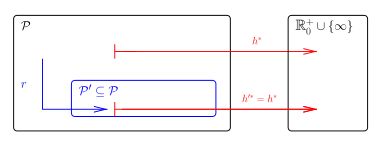
where, for all \(\Pi \in \mathcal P\), \(h^*(r(\Pi)) \leq h^*(\Pi)\).
For \(h^+ = h^* \circ r\):
Problem \(\mathcal P\): All STRIPS planning tasks.
Simpler problem \(\mathcal P'\): All STRIPS planning tasks with empty deletes.
Perfect heuristic \(h^{\prime *}\) for \(\mathcal P'\): Optimal plan cost \(= h^*\) on \(\mathcal P'\).
Transformation \(r\): Drop the deletes.
Is this a native relaxation? Yes.
Is this relaxation efficiently constructible? Yes.
Is this relaxation efficiently computable? No.
Indiana Jones’ Maze Domain?
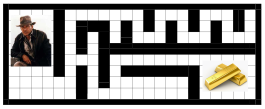
(A): No, relaxed plans can’t walk through walls.
(B): Yes, optimal plan = shortest path = relaxed plan (deletes do not matter because “shortest paths never walk back”).
(C), (D): No, relaxed plans must move both horizontally and vertically.
Bellman-Ford for \(h^{max}\) in TSP Example?
\(P\): \(\mathit{at}(X)\) for \(X \in \{\mathit{Sy}, \mathit{Ad}, \mathit{Br}, \mathit{Pe}, \mathit{Ad}\}\); \(\mathit{v}(X)\) for \(X \in \{\mathit{Sy}, \mathit{Ad}, \mathit{Br}, \mathit{Pe}, \mathit{Ad}\}\).
\(A\): \(\mathit{drive}(X,Y)\) where \(X,Y\) have a road. \[ c(\mathit{drive}(X,Y)) = \left \{ \begin{array}[]{ll} 1 & \{X,Y\} = \{\mathit{Sy}, \mathit{Br}\}\\ 1.5 & \{X,Y\} = \{\mathit{Sy}, \mathit{Ad}\}\\ 3.5 & \{X,Y\} = \{\mathit{Ad}, \mathit{Pe}\}\\ 4 & \{X,Y\} = \{\mathit{Ad}, \mathit{Da}\} \end{array} \right. \]
\(I\): \(\mathit{at}(\mathit{Sy}), \mathit{v}(\mathit{Sy})\); \(G\): \(\mathit{at}(\mathit{Sy}), \mathit{v}(X) \text{ for all } X\).
Content of Tables \(T^{add}_i\)?: where \(T^{add}_i\) denotes table entry after \(i\)-th Bellman-Ford iteration?
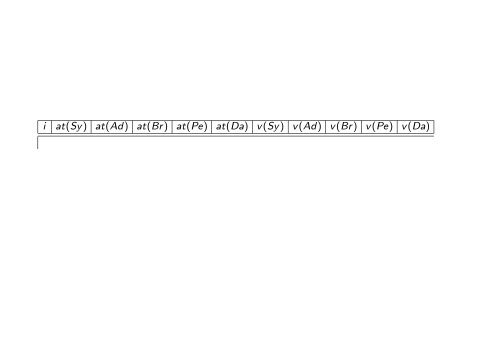
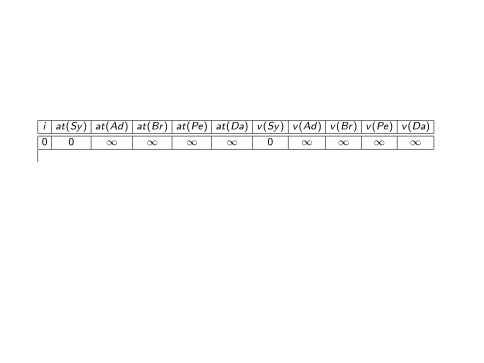
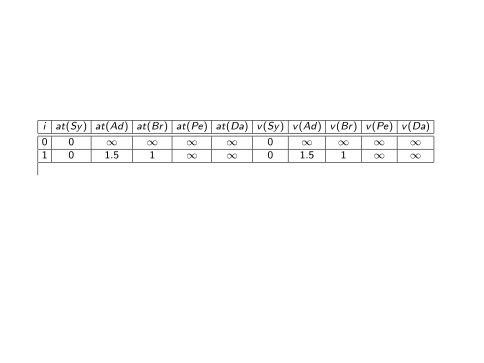
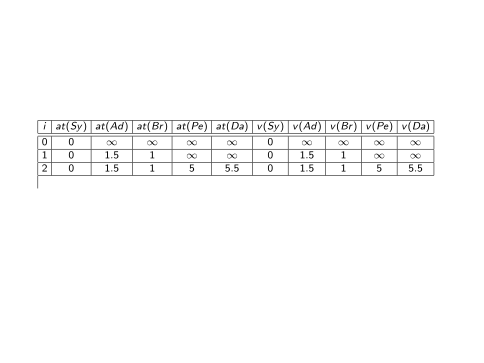
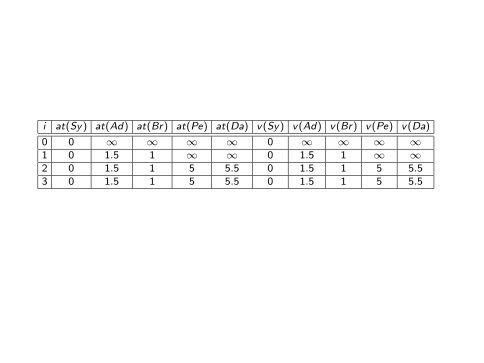
\({\color{red}h^{max}(I)=}\) \(5.5 << 20 = h^*(I)\).
Bellman-Ford for \(h^{add}\) in TSP Example?
\(P\): \(\mathit{at}(X)\) for \(X \in \{\mathit{Sy}, \mathit{Ad}, \mathit{Br}, \mathit{Pe}, \mathit{Ad}\}\); \(\mathit{v}(X)\) for \(X \in \{\mathit{Sy}, \mathit{Ad}, \mathit{Br}, \mathit{Pe}, \mathit{Ad}\}\).
\(A\): \(\mathit{drive}(X,Y)\) where \(X,Y\) have a road. \[ c(\mathit{drive}(X,Y)) = \left \{ \begin{array}[]{ll} 1 & \{X,Y\} = \{\mathit{Sy}, \mathit{Br}\}\\ 1.5 & \{X,Y\} = \{\mathit{Sy}, \mathit{Ad}\}\\ 3.5 & \{X,Y\} = \{\mathit{Ad}, \mathit{Pe}\}\\ 4 & \{X,Y\} = \{\mathit{Ad}, \mathit{Da}\} \end{array} \right. \]
\(I\): \(\mathit{at}(\mathit{Sy}), \mathit{v}(\mathit{Sy})\); \(G\): \(\mathit{at}(\mathit{Sy}), \mathit{v}(X) \text{ for all } X\).
Content of Tables \(T^{add}_i\)?: where \(T^{add}_i\) denotes table entry after \(i\)-th Bellman-Ford iteration?
\({\color{red}h^{add}(I)=}\) \(1.5 + 1 + 5 + 5.5 = 13 > 10 = h^+(I)\). But \(< 20 = h^*(I)\).
\(h^{add}(I) > h^+(I)\) because it counts the cost of \(\mathit{drive}(\mathit{Sy},\mathit{Ad})\) 3 times:
As part of \(h^{add}(I,\{\mathit{v}(\mathit{Ad})\})\), \(h^{add}(I,\{\mathit{v}(\mathit{Pe})\})\), and \(h^{add}(I,\{\mathit{v}(\mathit{Da})\})\)!
Difference between \(h^{add}\) & \(h^{max}\) in Logistics?

- Initial state \(I\): \(t(A), p(C)\)
- Goal \(G\): \(t(A), p(D)\)
- Actions \(A\): dr(X,Y), lo(X), ul(X).
Content of Tables ?: \(T^{add}_i\) entries are denoted in black and \({\color{red}T^{max}_i}\) in red.
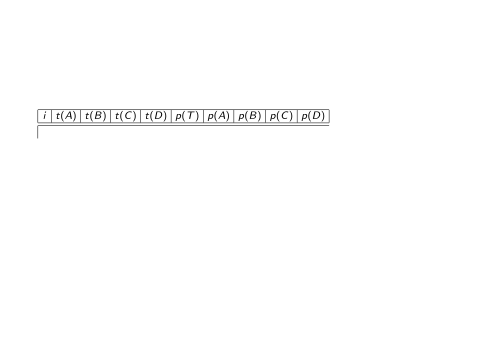
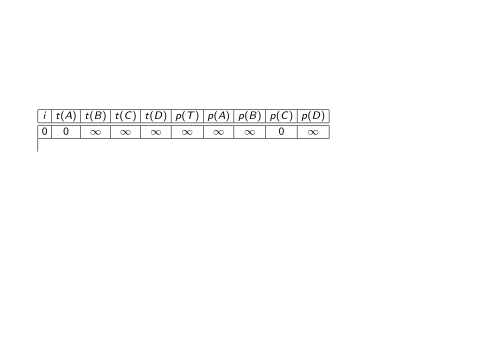
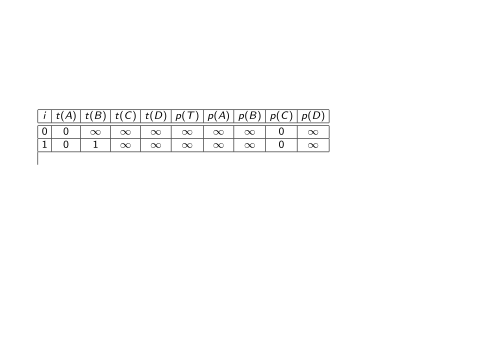
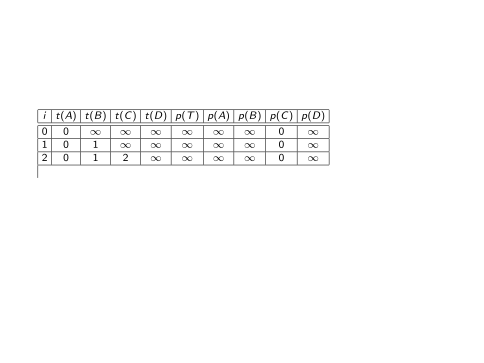
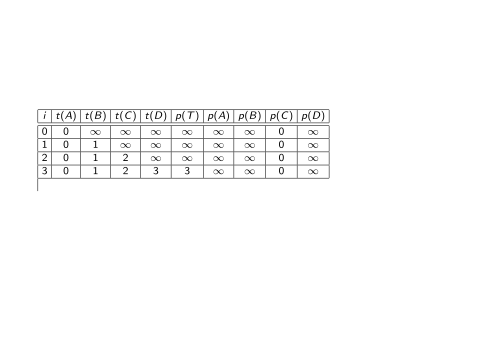
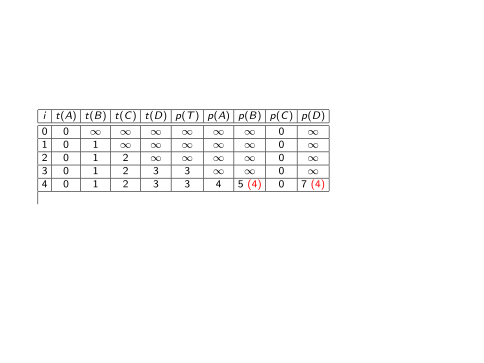
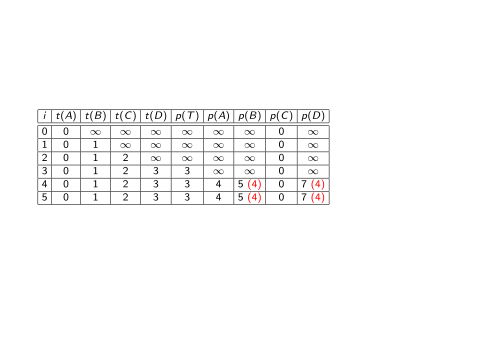
\({\color{red} h^{add}(I)=}\) \(7 > h^+(I) = 5\), but \(< 8 = h^*(I)\).
\(h^{add}(I) > h^+(I)\) because? It counts the cost of \(\mathit{dr}(A,B), \mathit{dr}(B,C)\) 2 times, for the two preconditions \(\mathit{p}(T)\) and \(\mathit{t}(D)\) of achieving \(\mathit{p}(D)\).
So, what if \(G = \{\mathit{t}(D), \mathit{p}(D)\}\)? \(h^{add}(I)=\) \(10 > 5 = h^*(I) = h^+(I)\) because now \(\mathit{dr}(A,B), \mathit{dr}(B,C), \mathit{dr}(C,D)\) is counted also as part of the goal \(\mathit{t}(D)\).
Best-Supporter Functions
Example \(h^{add}\) in Logistics:
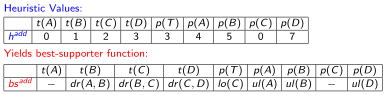
Relaxed Plan Extraction from \(h^{add}\) in Logistics?
- Initial state \(I\): \(t(A), p(C)\)
- Goal \(G\): \(t(A), p(D)\)
- Actions \(A\): dr(X,Y), lo(X), ul(X).

Extracting a relaxed plan:
\(bs^{add}_s(\mathit{p}(D)) =\) \(\mathit{ul}(D)\); opens \(\mathit{t}(D), \mathit{p}(T)\).
\(bs^{add}_s(\mathit{t}(D)) =\) \(\mathit{dr}(C,D)\); opens\(\;\mathit{t}(C)\).
\(bs^{add}_s(\mathit{t}(C)) =\) \(\mathit{dr}(B,C)\); opens\(\;\mathit{t}(B)\).
\(bs^{add}_s(\mathit{t}(B)) =\) \(\mathit{dr}(A,B)\); opens nothing.
\(bs^{add}_s(\mathit{p}(T)) =\) \(\mathit{lo}(C)\); opens nothing.
Anything more? No, open goals empty at this point.
\({\color{red}\mathit{h^{\mathit{FF}}(I)=}}\) \(5 = h^+(I) < 7 = h^{add}(I) < 8 = h^*(I)\).
What if \(G = \{\mathit{t}(D), \mathit{p}(D)\}\)? \(h^{\mathit{FF}}(I)=\) \(5 = h^+(I) = h^*(I)\) because relaxed plan extraction selects the drive actions only once. By contrast, \(h^{add}(I) = 10\) overcounts these actions, c.f. Bellman-Ford for \(h^{add}\) in Logistics
Support Graphs and Prerequisite (C) in Logistics
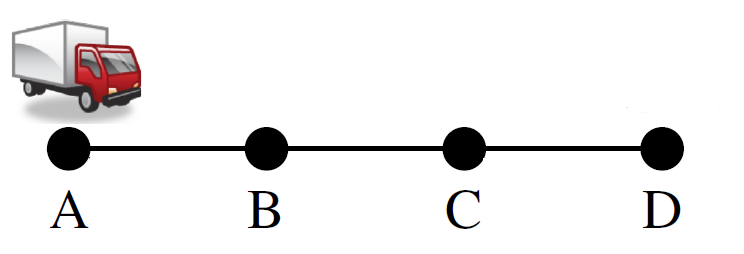
- Initial state: \(\mathit{t}A\).
- Goal: \(\mathit{t}D\).
- Actions: \(\mathit{dr}XY\).
How to do it (well-founded)


How NOT to do it (not well-founded)

