05 Markov Decision Processes (MDPs)

Introduction to Markov Decision Processes (MDPs)

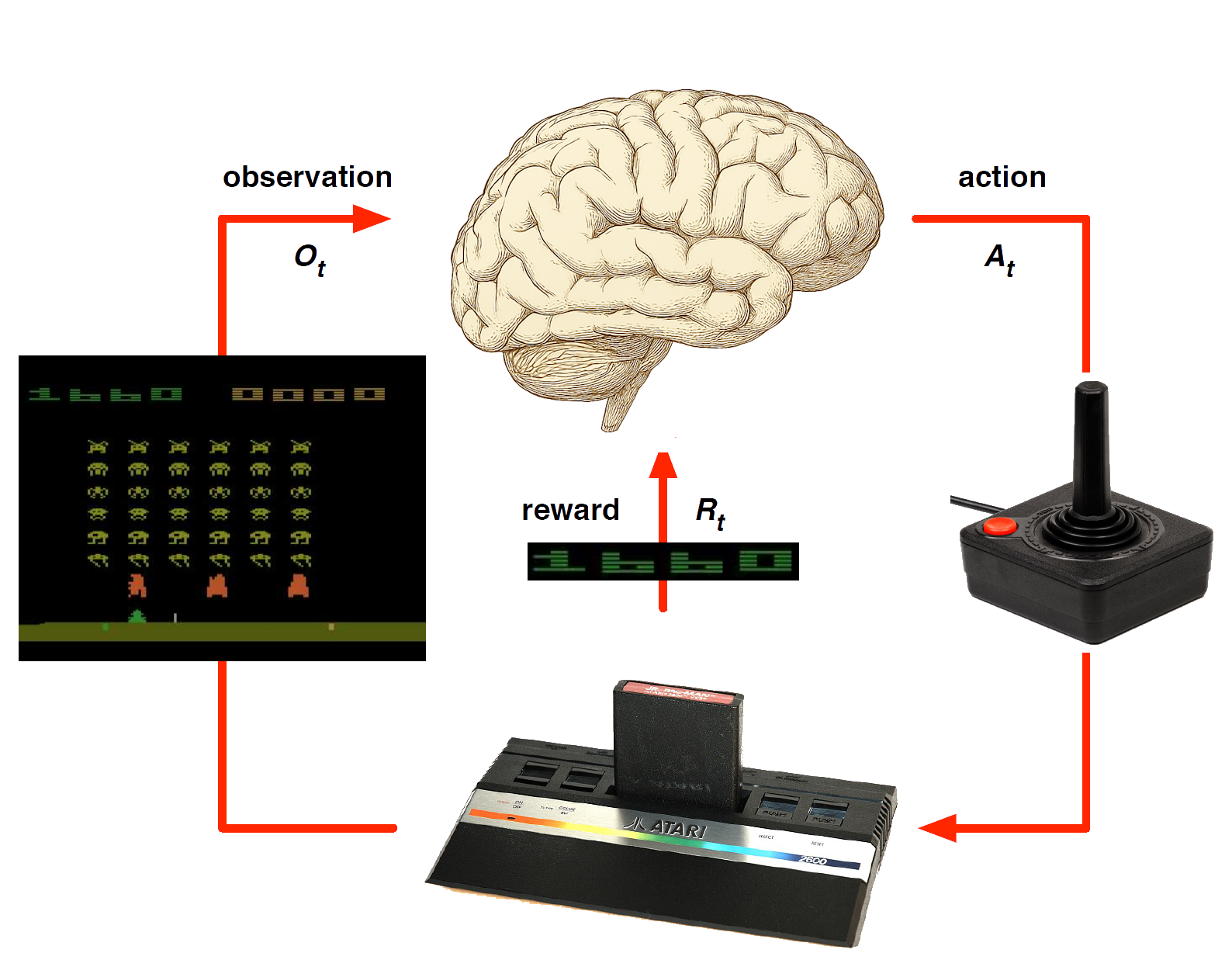
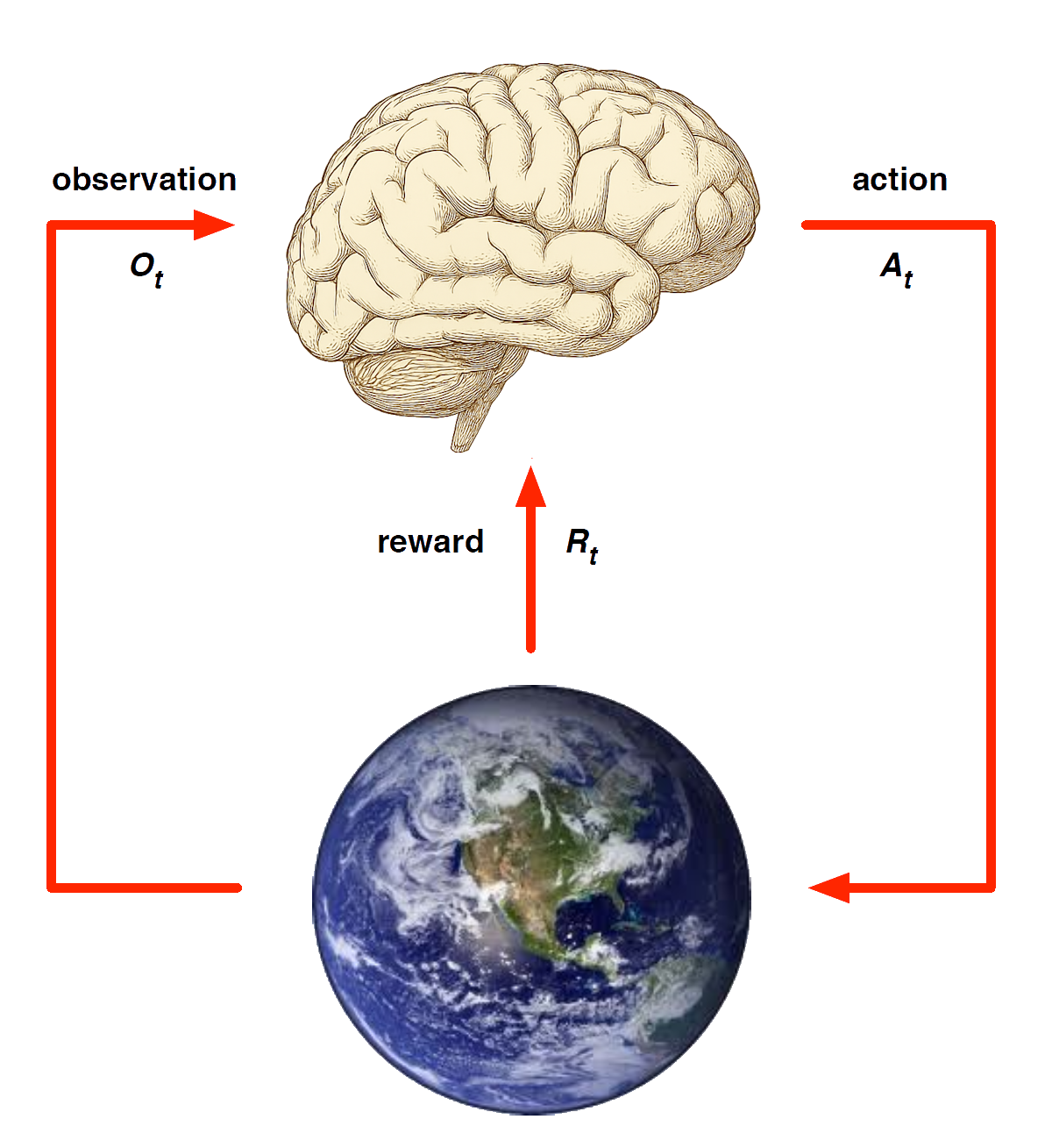
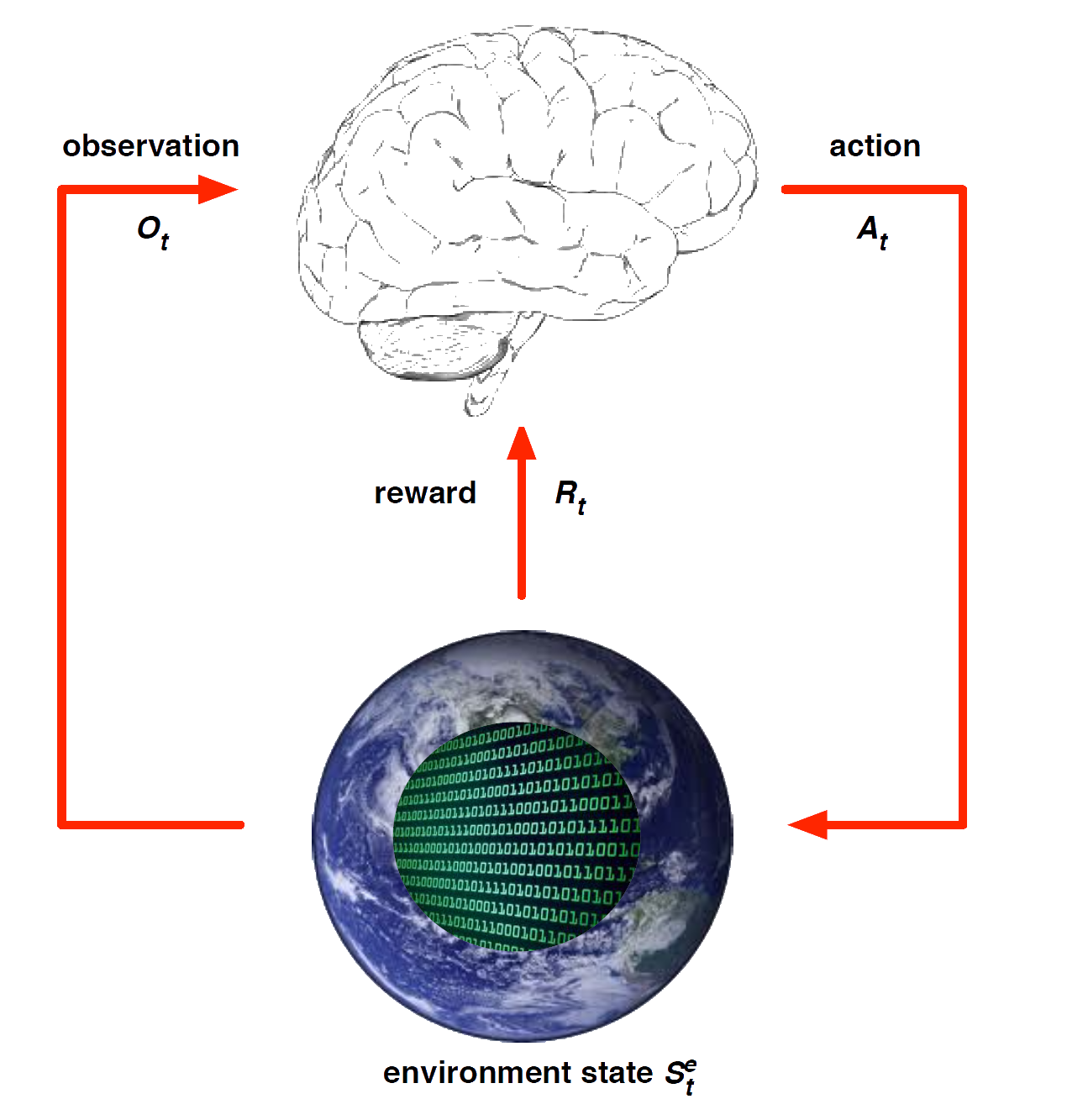
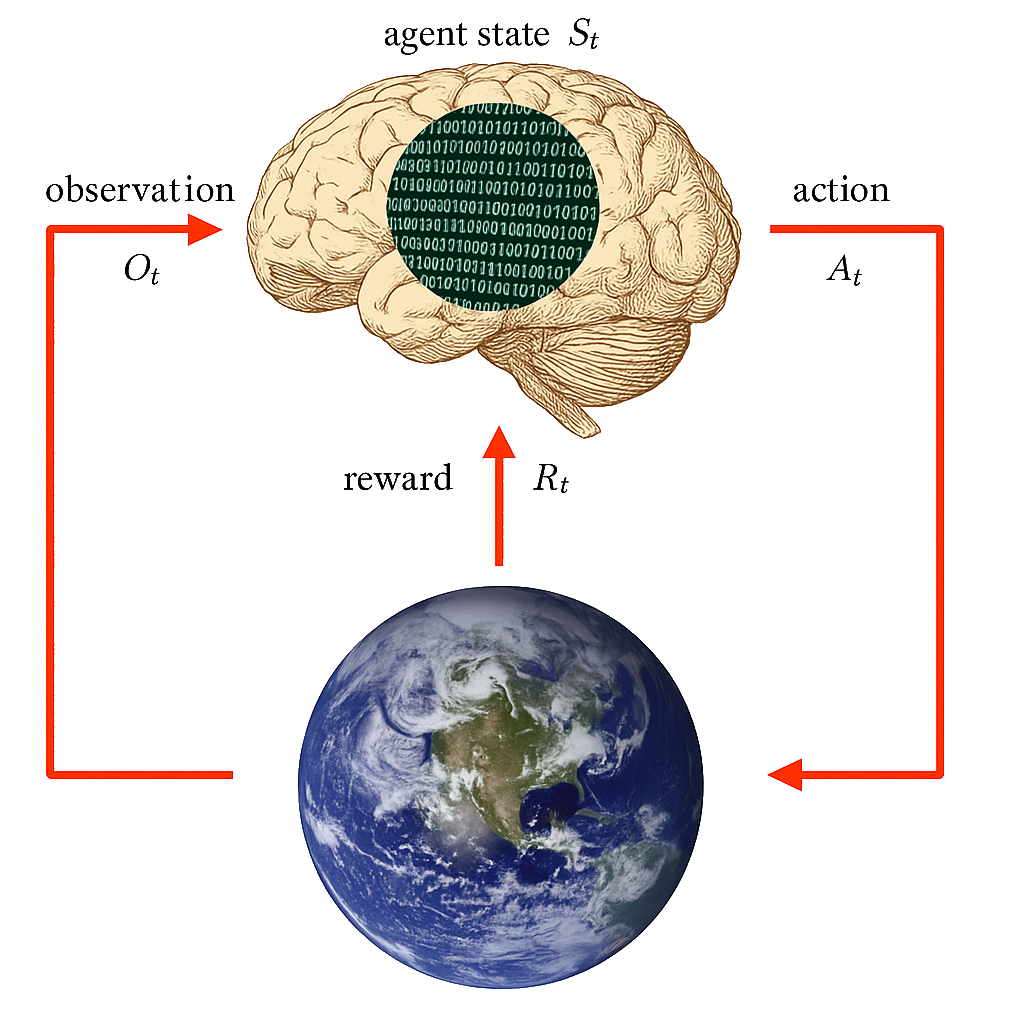
Markov decision processes formally describe an environment for reinforcement learning

Where the environment is fully observable -i.e. The current state completely characterises the process

Almost all RL problems can be formalised as MDPs, e.g.

  • Optimal control primarily deals with continuous MDPs
  • Partially observable problems can be converted into MDPs
  • Bandits (from machine learning) are MDPs with just one state

Markov Decision Process

A Markov decision process (MDP) is a Markov reward process with decisions.

  • It is an environment in which all states are Markov.

  • We introduced agency in terms of actions.

Definition

A Markov Decision Process is a tuple \(<\mathcal{S}, \mathcal{\textcolor{red}{A}}, \mathcal{P}, \mathcal{R}, \gamma>\)

  • \(\mathcal{S}\) is a finite set of states

  • \(\mathcal{\color{red}{A}}\) is a finite set of actions

  • \(\mathcal{P}\) is a state transition probability matrix, \(P^{\textcolor{red}{a}}_{ss'} = \mathbb{P} [S_{t+1} = s'\ | S_t = s, A_t = \textcolor{red}{a}]\)

  • \(\mathcal{R}\) is a reward function, \(\mathcal{R}^{\textcolor{red}{a}}_s = \mathbb{E}[R_{t+1}\ |\ S_t = s, A_t = {\textcolor{red}{a}}]\)

  • \(\gamma\) is a discount factor \(\gamma \in [0,1]\).

Example: Student MDP

Agent exerts control over MDP via actions, and goal is to find the best path through decision making process to maximise rewards

Policies (1)

Definition

A (stochastic) policy \(\pi\) is a distribution over actions given states,

\[ \pi(a \mid s) = \mathbb{P}\!\left[\, A_t = a \;\middle|\; S_t = s \,\right] \]

  • A policy fully defines the behaviour of an agent

  • MDP policies depend on the current state (not the history)

  • i.e. Policies are stationary (time-independent), \(A_t \sim \pi(\,\cdot \mid S_t), \quad \forall t > 0\)

Policies (2) - Recovering Markov reward process from MDP

Given an MDP \(\mathcal{M} = \langle \mathcal{S}, \mathcal{A}, \mathcal{P}, \mathcal{R}, \gamma \rangle\) and a policy \(\pi\)

  • The state sequence \(S_1, S_2, \ldots\) is a Markov process \(\langle \mathcal{S}, \mathcal{P}^\pi \rangle\)

  • The state and reward sequence \(S_1, R_2, S_2, \ldots\) is a Markov reward process \(\langle \mathcal{S}, \mathcal{P}^\pi, \mathcal{R}^\pi, \gamma \rangle\), where

\[ \mathcal{P}^{\pi}_{s,s'} = \sum_{a \in \mathcal{A}} \pi(a \mid s)\, \mathcal{P}^{a}_{s s'} \]

\[ \mathcal{R}^{\pi}_{s} = \sum_{a \in \mathcal{A}} \pi(a \mid s)\, \mathcal{R}^{a}_{s} \]

Value Function

Definition

The state-value function \(v_\pi(s)\) of an MDP is the expected return starting from state \(s\), and then following policy \(\pi\)

\[ v_\pi(s) = \mathbb{E}_\pi \!\left[\, G_t \;\middle|\; S_t = s \,\right] \]

Definition

The action-value function \(q_\pi(s, a)\) is the expected return starting from state \(s\), taking action \(a\), and then following policy \(\pi\)

\[ q_\pi(s, a) = \mathbb{E}_\pi \!\left[\, G_t \;\middle|\; S_t = s,\, A_t = a \,\right] \]

Example: State-Value Function for Student MDP

Bellman Expectation Equation

The state-value function can again be decomposed into immediate reward plus discounted value of successor state,

\[ v_\pi(s) = \mathbb{E}_\pi \!\left[\, R_{t+1} + \gamma v_\pi(S_{t+1}) \;\middle|\; S_t = s \,\right] \]


Can do the same thing for the \(q\) values: the action-value function can similarly be decomposed,

\[ q_\pi(s, a) = \mathbb{E}_\pi \!\left[\, R_{t+1} + \gamma q_\pi(S_{t+1}, A_{t+1}) \;\middle|\; S_t = s,\, A_t = a \,\right] \]

Bellman Expectation Equation for \(V^{\pi}\) (look ahead)


\[ v_\pi(s) = \sum_{a \in \mathcal{A}} \pi(a \mid s)\, q_\pi(s, a) \]

Bellman Expectation Equation for \(Q^{\pi}\) (look ahead)


\[ q_\pi(s, a) = \mathcal{R}^a_s + \gamma \sum_{s' \in \mathcal{S}} \mathcal{P}^a_{s s'}\, v_\pi(s') \]

Bellman Expectation Equation for \(v_{\pi} (2)\)

Bringing it together: agent actions (open circles), environment actions (closed circles)

\[ v_\pi(s) = \sum_{a \in \mathcal{A}} \pi(a \mid s) \left( \mathcal{R}^a_s + \gamma \sum_{s' \in \mathcal{S}} \mathcal{P}^a_{s s'} \, v_\pi(s') \right) \]

Bellman Expectation Equation for \(q_{\pi} (2)\)

The other way around: can do same thing for action values

\[ q_\pi(s, a) = \mathcal{R}^a_s + \gamma \sum_{s' \in \mathcal{S}} \mathcal{P}^a_{s s'} \sum_{a' \in \mathcal{A}} \pi(a' \mid s') \, q_\pi(s', a') \]

In both forms value function is (recursively) equal to reward of immediate state \(s\) + value \(s'\) (where you end up)

Example: Bellman Expectation Equation in Student MDP

Verify Bellman Equation to compute \(v_{\pi}(s)\) for \(s=C3\)

Bellman Expectation Equation (Matrix Form)

The Bellman expectation equation can be expressed concisely using the induced MRP (as before),

\[ v_\pi = \mathcal{R}^\pi + \gamma \mathcal{P}^\pi v_\pi \]

with direct solution

\[ v_\pi = (I - \gamma \mathcal{P}^\pi)^{-1} \mathcal{R}^\pi \]

  • Bellman equation gives us description of system can solve

  • Essentially averaging then computing inverse, although inefficient!

Optimal Value Function

Optimal Value Function (Finding the best behaviour)

Definition

The optimal state-value function \(v_\ast(s)\) is the maximum value function over all policies

\[ v_\ast(s) = \max_{\pi} v_\pi(s) \]

The optimal action-value function \(q_\ast(s, a)\) is the maximum action-value function over all policies

\[ q_\ast(s, a) = \max_{\pi} q_\pi(s, a) \]

  • The optimal value function specifies the best possible performance in the MDP.

  • An MDP is “solved” when we know the optimal value function.

  • If you know \(q_\ast\), you have the optimal value function

  • So solving means finding \(q_\ast\)

Example: Optimal Value Function for Student MDP

Gives us value function for each state \(s\) (not how to behave)

Example: Optimal Action-Value Function for Student MDP

Gives us best action, \(a\), for each state \(s\) (can choose)

Optimal Policy

Define a partial ordering over policies

\[ \pi \;\geq\; \pi' \quad \text{if } v_\pi(s) \;\geq\; v_{\pi'}(s), \;\forall s \]

Theorem For any Markov Decision Process

  • There exists an optimal policy \(\pi_\ast\) that is better than or equal to all other policies, \(\pi_\ast \geq \pi, \;\forall \pi\)

  • All optimal policies achieve the optimal value function, \(v_{\pi_\ast}(s) = v_\ast(s)\)

  • All optimal policies achieve the optimal action-value function, \(q_{\pi_\ast}(s,a) = q_\ast(s,a)\)

Finding an Optimal Policy

An optimal policy can be found by maximising over \(q_\ast(s,a)\),

\[ \pi_\ast(a \mid s) = \begin{cases} 1 & \text{if } a = \underset{a \in \mathcal{A}}{\arg\max}\; q_\ast(s,a) \\[6pt] 0 & \text{otherwise} \end{cases} \]

  • There is always a deterministic optimal policy for any MDP
  • If we know \(q_\ast(s,a)\), we immediately have the optimal policy

Example: Optimal Policy for Student MDP

Red arcs (actions) represent optimal policy: picks highest \(q_\ast\)

Bellman Optimality Equation for \(v_\ast\) (look ahead)

The optimal value functions are recursively related by the Bellman optimality equations:

\[ v_\ast(s) = \max\limits_{a} q_\ast(s,a) \]

Working backwards using backup diagrams we get \(v_\ast(s)\) - best action over all policies taking max instead of average

Bellman Optimality Equation for \(Q^\ast\) (look ahead)


\[ q_\ast(s,a) = \mathcal{R}^a_s + \gamma \sum_{s' \in \mathcal{S}} \mathcal{P}^a_{ss'} \, v_\ast(s') \]

Considers where the environment might take us by averaging (looking ahead) and backing up (inductively)

Bellman Optimality Equation for \(V^* (2)\)

Bringing it together (two-step look ahead): agent actions (open circles), environment actions (closed circles)

\[ v_\ast(s) = \max\limits_{a} \mathcal{R}^a_s + \gamma \sum_{s' \in \mathcal{S}} \mathcal{P}^a_{ss'} \, v_\ast(s') \]

Bellman Optimality Equation for \(Q^* (2)\)


\[ q_\ast(s,a) = \mathcal{R}^a_s + \gamma \sum_{s' \in \mathcal{S}} \mathcal{P}^a_{ss'} \, \max\limits_{a'} q_\ast(s',a') \]

Determines \(Q^{\ast}\) reordering from environments perspective

Example: Bellman Optimality Equation in Student MDP

Compute \(v_{\ast}(s)\) for \(s=C1\) looking one step ahead (no environment actions in \(C1\))

Solving the Bellman Optimality Equation

Bellman Optimality Equation is non-linear

  • No closed form solution (in general)

Many iterative solution methods

  • Value Iteration (not covered in this subject)
  • Policy Iteration (not covered in this subject)
  • Q-learning (covered in Module 9)
  • SARSA (covered in Module 9)

Model-Based Reinforcement Learning


Last Module: Learning & Relxation

This Module: learn model directly from experience

  • \(\ldots\) and use planning to construct a value function or policy

Integrates learning and planning into a single architecture

Model-Based Reinforcement Learning

Model-Based and Model-Free RL

Model-Free RL

  • No model

  • Learn value function (and/or policy) from experience

Model-Based RL

  • Learn a model from experience

  • Plan value function (and/or policy) from model

Lookahead by planning (or thinking) about what the value function will be

Model-Free RL

Model-Based RL

Replace real world with the agent’s (simulated) model of the environment

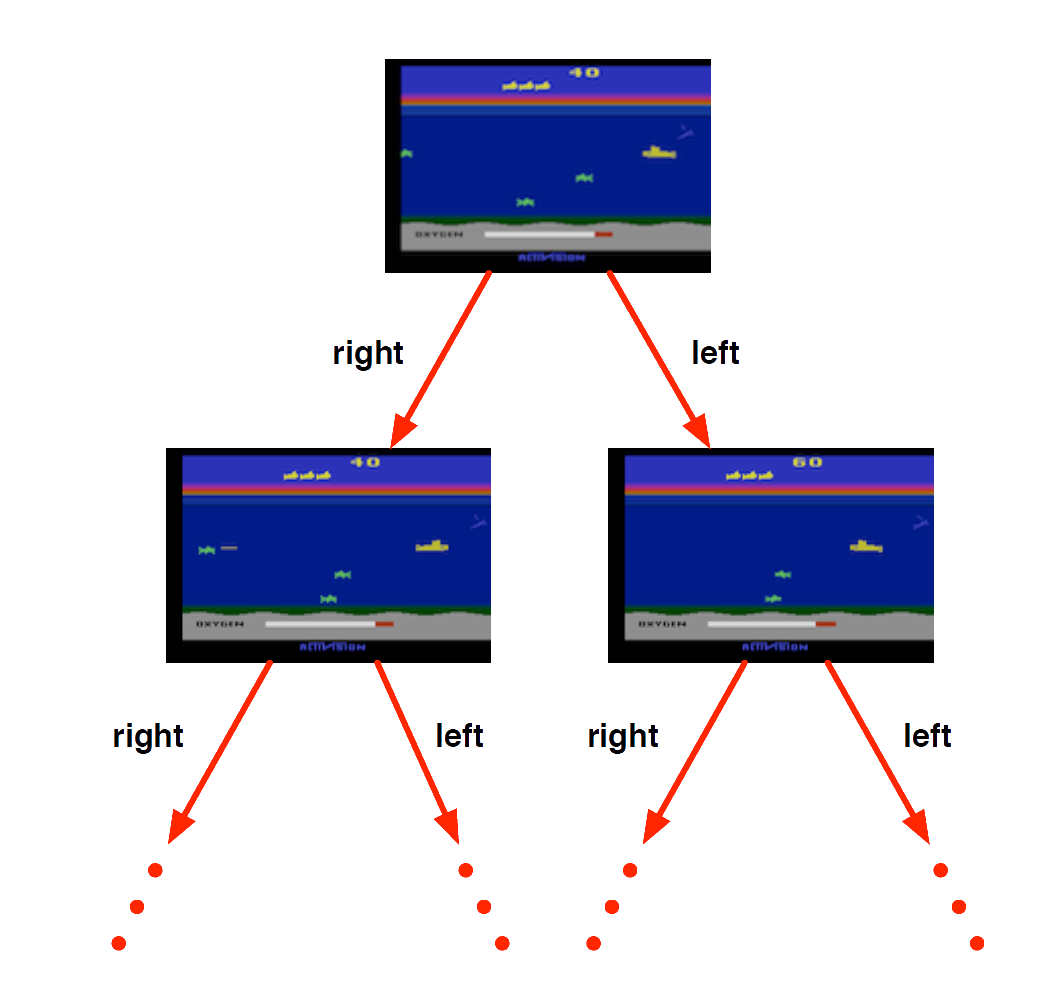
  • Supports rollouts (lookaheads) under imagined actions to reason about what value function will be, without further environment interaction

Model-Based RL (2)

Advantages of Model-Based RL

Advantages:

  • Can efficiently learn model by supervised learning methods

  • Can reason about model uncertainty, and even take actions to reduce uncertainty

Disadvantages:

  • First learn a model, then construct a value function

\(\;\;\;\Rightarrow\) two sources of approximation error

Learning a Model

What is a Model?

A model \(\mathcal{M}\) is a representation of an MDP \(\langle \mathcal{S}, \mathcal{A}, \mathcal{P}, \mathcal{R} \rangle\), parameterised by \(\eta\)

  • We will assume state space \(\mathcal{S}\) and action space \(\mathcal{A}\) are known

So a model \(\mathcal{M} = \langle \mathcal{P}_\eta, \mathcal{R}_\eta \rangle\) represents state transitions
\(\mathcal{P}_\eta \approx \mathcal{P}\) and rewards \(\mathcal{R}_\eta \approx \mathcal{R}\)

\[ S_{t+1} \sim \mathcal{P}_\eta(S_{t+1} \mid S_t, A_t) \]

\[ R_{t+1} = \mathcal{R}_\eta(R_{t+1} \mid S_t, A_t) \]

Typically assume conditional independence between state transitions and rewards

\[ \mathbb{P}[S_{t+1}, R_{t+1} \mid S_t, A_t] \;=\; \mathbb{P}[S_{t+1} \mid S_t, A_t] \; \mathbb{P}[R_{t+1} \mid S_t, A_t] \]

Note you can learn from each (one-step) transition, treating the following step as the supervisor for the prior step.

Model Learning

Goal: estimate model \(\mathcal{M}_\eta\) from experience \(\{S_1, A_1, R_2, \ldots, S_T\}\)

This is a supervised learning problem

\[ \begin{aligned} S_1, A_1 &\;\to\; R_2, S_2 \\ S_2, A_2 &\;\to\; R_3, S_3 \\ &\;\vdots \\ S_{T-1}, A_{T-1} &\;\to\; R_T, S_T \end{aligned} \]

  • Learning \(s,a \to r\) is a regression problem

  • Learning \(s,a \to s'\) is a density estimation problem

  • Pick loss function, e.g. mean-squared error, KL divergence, …

  • Find parameters \(\eta\) that minimise empirical loss

Examples of Models

  • Table Lookup Model

  • Linear Expectation Model

  • Linear Gaussian Model

  • Gaussian Process Model

  • Deep Belief Network Model

  • \(\cdots\) almost any supervised learning model

Table Lookup Model

Model is an explicit MDP, \(\hat{\mathcal{P}}, \hat{\mathcal{R}}\)

  • Count visits \(N(s,a)\) to each state–action pair (parametric approach)

\[ \begin{align*} \hat{\mathcal{P}}^{a}_{s,s'} & = \frac{1}{N(s,a)} \sum_{t=1}^T \mathbf{1}(S_t, A_t, S_{t+1} = s, a, s')\\[0pt] \hat{\mathcal{R}}^{a}_{s} & = \frac{1}{N(s,a)} \sum_{t=1}^T \mathbf{1}(S_t, A_t = s, a)\, R_t \end{align*} \]

  • Alternatively (a simple non-parametric approach)
    • At each time-step \(t\), record experience tuple \(\langle S_t, A_t, R_{t+1}, S_{t+1} \rangle\)
    • To sample model, randomly pick tuple matching \(\langle s,a,\cdot,\cdot \rangle\)

AB Example (Revisited) - Building a Model

Two states \(A,B\); no discounting; \(8\) episodes of experience

\(A, 0, B, 0\)

\(B, 1\)

\(B, 1\)

\(B, 1\)

\(B, 1\)

\(B, 1\)

\(B, 1\)

\(B, 0\)

We have constructed a table lookup model from the experience